
License: CC BY 4.0 DOI: 10.5281/zenodo.20633176 (concept DOI — always resolves to the latest version)
Canonical version declaration. The TLCTC framework specification is v2.7. The normative authority for cluster definitions, axioms, and classification rules is exactly one artifact: the machine-readable framework dictionary
json-schemas/layer-1/tlctc-framework.v2.7.json; this paper reproduces those verbatim and supplies the derivation, notation, and per-cluster boundary tests around them. The boundary tests are normative and are homed in this paper (Section 4) by design — the dictionary deliberately carries no boundary-test field. Companion documents (application paper, glossary, mappings, tools) declare which canonical version they implement. Retired rule aliases from earlier versions (R-ABUSE, R-HUMAN, R-PHYSICAL from v2.0; R-FLOOD, R-CHANNEL, R-SUBSTRATE from v2.5) are enumerated in Section 6 and are never reused with a different meaning.
Cybersecurity discourse routinely uses the term "cyber threat" to denote several distinct concepts at once: the cause of a compromise, its outcome, the actor responsible, and the technique employed. This conflation impedes consistent classification, comparable incident documentation, and clear communication of cyber risk between leadership, risk functions, and technical teams. Established frameworks address adjacent layers — control objectives, adversary techniques, software weaknesses, and quantitative risk — but none provides a compact, non-overlapping taxonomy on the cause side that holds stable across system types. The Top Level Cyber Threat Clusters (TLCTC) framework proposes ten top-level threat clusters, each defined by the single generic vulnerability it initially targets. The taxonomy separates threats (causes) from system events, data risk events, business consequences, and actor identity. This paper presents the framework's derivation logic, its design principles and threat topology, the ten cluster definitions, the ten axioms that constrain interpretation, and the classification rules that keep assignment reproducible, together with example mappings expressed in an attack-path notation. By distinguishing a stable strategic management view from a concrete operational security view, TLCTC functions as a translation layer linking strategic risk governance, security operations, and secure software development.
Keywords: cyber threat taxonomy; cyber risk taxonomy; cybersecurity ontology; cyber threat classification; threat modeling; cause-oriented taxonomy; TLCTC; Top Level Cyber Threat Clusters
1. Introduction and Problem Statement
Cybersecurity suffers from a persistent language problem: the field describes fundamentally different things using the same words, and uses different words for the same thing. In practice, the term "cyber threat" is routinely mixed with threat actors, vulnerabilities, control failures, incidents, and outcomes such as data breach, denial of service, or ransomware. A single label is asked to carry the cause of a compromise, the technique used to achieve it, the actor who carried it out, and the consequence that followed. These are categorically distinct concepts, and collapsing them into one term blurs the boundary between why a compromise becomes possible and what happens once it does.
This semantic diffusion — the absence of a shared, stable meaning for the field's core terms — has practical costs. When cause, technique, actor, and outcome share a vocabulary, it becomes difficult to compare incidents across organizations, aggregate threat intelligence into stable categories, design controls that target a specific root weakness, or communicate cyber risk consistently between leadership, risk functions, and technical teams. The same event may be classified differently by two analysts not because they disagree about the facts, but because the underlying terms admit multiple readings. Outcome-named categories such as "ransomware" or "data breach" compound the problem: they describe an effect, not the generic vulnerability an attacker exploited, so they cannot anchor a reproducible mapping from threat to control. The condition is not mere terminological untidiness: threat-intelligence vendors and agencies each report under their own scheme — adversary groups, e-crime categories, threat-landscape buckets — so accounts of the same event resist combination. In Kuhn's terms, the field remains pre-paradigmatic: competing schools coexist, each with its own terminology, methods, and explanatory models, with no shared foundation that lets their results accumulate [12].
Existing frameworks address adjacent layers of this space but leave the cause side underspecified. Control catalogues and management standards (e.g. the NIST Cybersecurity Framework, and risk-assessment guidance such as NIST SP 800-30) organize what an organization should do; adversary-technique knowledge bases (e.g. MITRE ATT&CK) enumerate observed behaviours; attack-pattern catalogues (e.g. MITRE CAPEC) describe attack mechanisms; software-weakness and vulnerability registries (e.g. MITRE CWE and CVE) catalogue concrete defects; and quantitative methods (e.g. FAIR) estimate loss. Adjacent threat-classification and attack-lifecycle models — STRIDE, VERIS, the Lockheed Martin Cyber Kill Chain, the Diamond Model, and threat-landscape reporting such as the ENISA Threat Landscape — describe techniques, incident attributes, intrusion phases, or observed activity. Each is valuable within its scope, yet none provides a compact, non-overlapping taxonomy of the generic vulnerabilities that compromises ultimately exploit — a stable backbone that holds across enterprise IT, cloud, OT, IoT, and endpoint environments without being tied to a particular technology or actor.
The Top Level Cyber Threat Clusters (TLCTC) framework addresses this gap by anchoring analysis in causality. A cyber threat is defined by the generic vulnerability (root weakness) it exploits, not by who performs it and not by the consequence that follows. The framework's contribution is a compact set of ten non-overlapping, cause-side threat clusters, each defined by the single generic vulnerability it initially targets. Threats are kept on the cause side and separated from outcomes, actor identity, and control failures, so that complete real-world intrusions can be expressed as ordered sequences of cluster steps — attack paths — without changing the meaning of the individual steps.
A further consequence of the same ambiguity is organizational. Strategic risk governance, security operations, and secure software development each describe threats in their own vocabulary, so a finding rarely travels intact from a board-level risk register to a SOC playbook to a developer's backlog. TLCTC is designed as a shared, cause-oriented vocabulary across these communities: a stable strategic management view (the ten clusters and their generic vulnerabilities) maps both to a concrete operational security view (specific vulnerabilities, techniques, and procedures) and to a development view (the design responsibility each cluster implies). The same cluster therefore names a threat consistently for the executive who must govern it, the analyst who must detect it, and the engineer who must prevent it.
TLCTC does not claim to be a finished paradigm. It is offered as a testable proposal for the shared foundation a paradigm would require — common axioms, definitions, and cause-side categories — so that, when independent analysts and vendors classify against the same clusters, their otherwise incompatible reports become combinable.
1.1 Positioning against VERIS and CAPEC
Two adjacent schemes come closest to TLCTC's cause side, and comparing them shows where the contribution lies.
VERIS [2] records each incident's actions in seven categories — Malware, Hacking, Social, Misuse, Physical, Error, Environmental — and several of them already separate what TLCTC separates. Table 1 reads the VERIS 1.4.1 action varieties in TLCTC terms, using the published 337-entry crosswalk (mappings/veris/, study in documentation/tlctc-veris-vcdb-study.md).
| VERIS action category | TLCTC reading (varieties) |
|---|---|
| Hacking | split by generic vulnerability: #2 ×29, #1 ×12, #4 ×7, #6 ×3, #3 ×3, #5 ×2, #7 ×1 |
| Malware | #7 ×31 (also #1 ×2, #4 ×2, #3 ×2, #2 ×1), with an enabling step VERIS does not record |
| Social | #9 ×10, #10 ×1 |
| Misuse | the Abuse of Rights row (13 of 15 varieties); #4 ×1 |
| Physical | #8 (10 of 14 varieties) |
| Error | Error in Use row (12), Failure row (4) |
| Environmental | Failure / external-event row (25) |
Table 1 — VERIS 1.4.1 action categories in TLCTC terms. Counts are varieties, not incidents; the remaining varieties are outcomes, vectors or unresolved values.
Misuse, Error and Environmental correspond to the three operational-risk rows of the cause-side partition (Section 3.5), so VERIS already keeps them apart from attack. TLCTC adds three things: it splits Hacking — the category that carries most of the cause — by the generic vulnerability exploited; it gives supply chain a cluster of its own, where VERIS records it as a vector or partner attribute; and it orders an incident's steps into a path with Δt between them. VERIS records an unordered set of actions, and its maintainers list sequencing as future work.
CAPEC [14] catalogues attack patterns under a Mechanisms of Attack view. Its categories group patterns by mechanism, which cuts across TLCTC's generic vulnerabilities (Table 2).
| CAPEC 3.9 category | Member patterns and their TLCTC cluster |
|---|---|
| 210 Abuse Existing Functionality | 212 Functionality Misuse #1 · 125 Flooding #6 · 216 Communication Channel Manipulation #5 |
| 225 Subvert Access Control | 94 Adversary in the Middle #5 · 560 Use of Known Domain Credentials #4 · 507 Physical Theft #8 |
| 152 Inject Unexpected Items | 248 Command Injection #2 → #7 · 624 Hardware Fault Injection #8 |
| 262 Manipulate System Resources | 438 Modification During Manufacture #10 · 176 Configuration/Environment Manipulation #1 |
Table 2 — Four CAPEC categories and the clusters their member patterns reach.
Abuse Existing Functionality is closest to #1 but also holds flooding and channel-manipulation patterns; Subvert Access Control spans credential use, interception and physical theft. CAPEC answers how an attack works; TLCTC answers which generic vulnerability it exploits. The two are complementary: CAPEC patterns attach beneath the clusters at the operational layer (Section 4), as ATT&CK techniques and CWE weaknesses do.
2. The Thought Experiment: Deriving the Ten Clusters
TLCTC is built by analytical decomposition under a stated criterion rather than by cataloguing observed attacks. An empirical catalogue grows with every new observation but never reaches closure; a purely heuristic grouping is convenient but cannot be shown to be wrong. The criterion is this: a cluster exists where a generic vulnerability has its own control lever and its own owner — a distinct way of reducing the exposure, held by a distinct accountable function. It is the same criterion Section 3.5 applies to keep Abuse of Rights out of the cluster set ("two levers, two owners, two registers"). The decomposition does not follow a single physical or logical principle, and it does not claim to: #2 and #3 share one weakness type split by the role of the flawed component, #4, #5 and #7 carve specific designed security functions out of designed functionality in general, and #6 names a resource property. What they share is the criterion. Two consequences follow and are stated rather than hidden. First, #1 (designed functionality) and #2/#3 (implementation flaws) are residual clusters: they apply only where no more specific generic vulnerability is the one exploited. Second, mutual exclusivity is produced by that precedence — normative as R-SPECIFIC (Section 6) — together with the boundary tests, not by an intrinsic disjointness of the descriptions; completeness is a falsifiable hypothesis (Section 8). Two devices carry this method: the thought experiment that follows, which decomposes the IT landscape one attack surface at a time into the generic vulnerabilities an attacker can target and names the control lever each one answers to, and the axioms (Section 5), which state explicitly the premises that constrain how the resulting clusters may be interpreted — the kind of foundation a shared language requires but that most threat vocabularies leave implicit.
The approach is also testable in Popper's sense [13]: each cluster carries boundary tests (Section 4) specifying the conditions under which a classification would be wrong. The supply-chain test is the clearest case — remove the attacker's subversion of the third party, not the third party itself, and if the attack still succeeds the step was never #10. A taxonomy that states how it could be falsified can be argued about on evidence rather than preference.
The ten TLCTC clusters are not an arbitrary enumeration or an industry convention; they result from a systematic decomposition of the attack surfaces present in information technology, each kept separate because it answers to its own control lever. Imagine the complex world of IT as a single object. Although robust and seemingly closed, this object exposes various attack surfaces — the generic vulnerabilities, or root weaknesses. Examining each surface in turn yields, one at a time, the full set of clusters.
1. Begin at the software asset. Concentrating first on the essentials, consider the functional domain and scope, and observe that every function can be abused and that more scope also means more attack surface. This yields the first threat cluster: Abuse of Functions. Its lever is the designed scope itself — narrowing functions, configuration surfaces and authorization; it is the residual cluster for designed behaviour that no more specific lever below covers.
2. Every piece of software, however well optimized, may contain code flaws that can be exploited — especially when the software is in a server role and processes attacker-controlled requests or inputs. This leads to the threat cluster: Exploiting Server. Its lever is secure implementation of server-role code — secure coding, testing and patching; with #3 it is the residual cluster for implementation flaws.
3. On the client side too, existing software code flaws can be exploited. This type of attack, where the client processes attacker-controlled resources or content during outbound interaction, manifests as the threat cluster: Exploiting Client. Its lever is the same implementation discipline applied to everything that consumes external content, owned where that client software is built and patched.
4. Software interacts with identities and credentials, both human and technical. When access-enabling identity artifacts — credentials, tokens, keys, session identifiers, and the like — are used or presented to impersonate an identity, they can be abused. This leads to the threat cluster: Identity Theft. Its lever is binding at the point of authentication — multi-factor authentication, session binding, replay detection.
5. Communication is crucial in a connected world. As data is transmitted between two points, rogue parties might eavesdrop, modify, or inject themselves into the exchange. This reveals the threat cluster: Man in the Middle. Its lever is control over the communication path — end-to-end protection and correct peer validation.
6. Continuous connectivity also makes systems susceptible to attacks that deliberately exhaust or overload resources and thereby degrade service. This leads to the threat cluster: Flooding Attack. Its lever is capacity management — limits, quotas, timeouts and scaling.
7. The digital landscape involves a continuous exchange of files and data. Some transfers introduce foreign executable content, and if such content is executed, it poses a threat. Here arises the threat cluster: Malware. Its lever is execution control — allow-listing, code signing and sandboxing.
8. Physical points of access and interaction remain, through which intruders might enter. This gives the threat cluster: Physical Attack. Its lever sits in a different control regime: physical security and the physical design of hardware.
9. The human factor must not be forgotten: people are susceptible to deception, manipulation, and misconduct. This human element leads to the threat cluster: Social Engineering. Its lever sits in the human decision domain: awareness, process and interface design.
10. Software and hardware ecosystems are almost always linked with third-party software, hardware, or services, and an organization accepts and relies on what they deliver. When an attacker subverts such a third party — its components, updates, or services — so that the target accepts the subverted artifact as authoritative, the trust itself becomes the attack surface. This leads to the final threat cluster: Supply Chain Attack. Its lever sits in third-party governance: provenance, verification, and trust that stays revocable.
Through this thought experiment and a careful examination of the vulnerabilities present in the IT landscape, ten distinct top-level cyber threat clusters result, one per control lever. The decomposition is intended to be complete; exclusivity is secured by R-SPECIFIC and the boundary tests (Section 3.2). It provides a clear structure and a deeper understanding of the diverse threats that IT systems, people, and processes face.
3. Taxonomy Design Principles and Threat Topology
3.1 Cause-Orientation and the Cause/Event/Consequence Separation
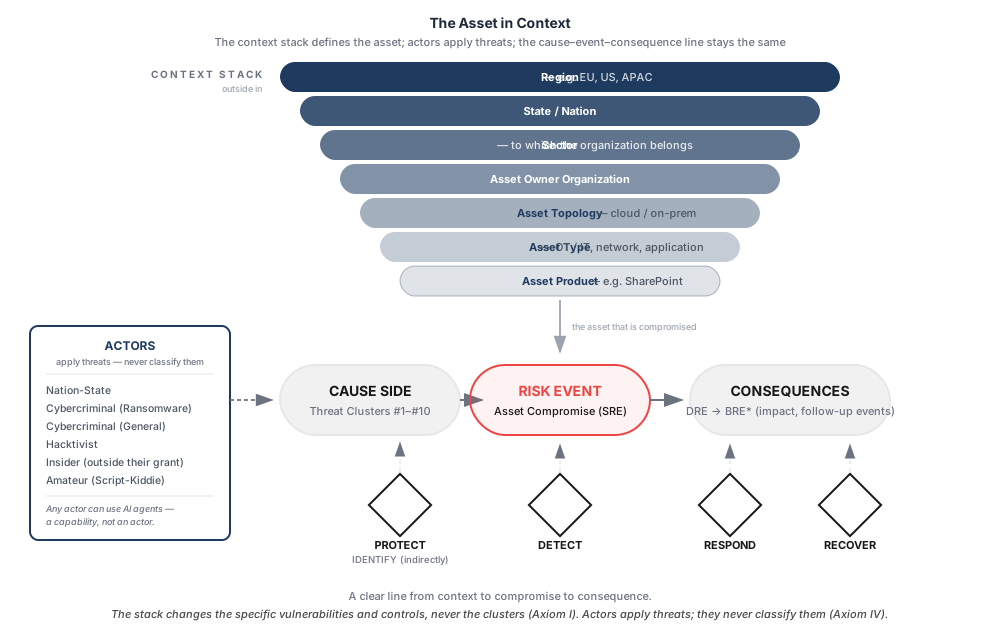
TLCTC is a cause-oriented taxonomy. A threat cluster sits on the cause side of an attack: it names the generic vulnerability an attacker exploits, not the event that follows or the consequence that results. Conceptually, this corresponds to the cause side of a bow-tie model, where threats are the causes that converge on a central risk event, and losses of confidentiality, integrity, or availability are recorded separately as outcomes on the consequence side. (Section 3.4 develops this cause–event–consequence model; the control side of the bow-tie — control frameworks, indicators, and governance mapping — belongs to a separate application document and is out of scope here.)

The practical consequence is that outcomes are never threats. Labels such as "data breach," "service outage," or "ransomware" describe effects, not the generic vulnerability that was exploited to produce them. They are recorded as data risk events on the consequence side, while the threat that caused them is classified by its cause. Keeping these layers apart is what allows two analysts to classify the same incident the same way and what makes mappings from threat to control reproducible.
3.2 Non-Overlap: One Generic Vulnerability, One Cluster
The taxonomy is built on a strict classification principle: every distinct attack step exploits exactly one generic vulnerability (root weakness), and each generic vulnerability belongs to exactly one of the ten clusters. The taxonomy is designed to produce non-overlapping assignments: the generic-vulnerability definitions, the boundary tests (Section 4), and the normative precedence rules (Section 6) together force each step to a unique cluster. Raw observable properties of a weakness may genuinely overlap — a missing certificate check is describable both as a code defect and as insufficient communication-path control — and it is the precedence rules (here the channel clause of R-SPECIFIC) that make the classification unique, not an intrinsic disjointness of the descriptions. The precedence has one direction: a specific generic vulnerability beats the residual tests of #1 and #2/#3 (R-SPECIFIC), because the specific cluster names the lever that actually reduces the exposure. A step that appears to belong to two clusters is, under this principle, two steps and must be split, each anchored in the single generic vulnerability it targets. Because each attack vector is defined by the generic vulnerability it initially targets, classification is anchored in the initial cause rather than in technique labels or downstream effects.
To remain universally applicable, the framework deliberately avoids differentiating by system type. Whether the environment is enterprise IT, cloud, SaaS, OT/SCADA, IoT, endpoints, or network infrastructure, the same foundational attack surfaces recur — software functions and implementation flaws, identity artifacts, communication paths, capacity limits, executable-content handling, physical accessibility, human psychology, and third-party trust dependencies. Sector labels do not create new threat classes; they change only the specific vulnerabilities and controls at the operational level. This supports a separation between a stable Strategic Management Layer (clusters and generic vulnerabilities, used for governance and control mapping) and an Operational Security Layer (concrete vulnerabilities, techniques, and procedures, used in detection, response, and engineering).
3.3 Threat Topology: Internal and Bridge
Beyond classification, each cluster carries a structural property called its threat topology, which describes whether the generic vulnerability is exploited within the software domain or from a different control regime. A domain is a set of assets governed by a coherent control regime — its policies, monitoring, enforcement, and accountability. Domains may be technical, organizational, or socio-technical (for example, the cyber/IT domain, the physical security domain, the human decision domain, or a vendor development domain).
TLCTC uses two topology types:
- Internal — the generic vulnerability is exploited within the software domain's control regime. Clusters #1 through #7 are internal: abuse of designed functions, server- and client-side implementation flaws, credential use within the identity domain, exploitation of insufficient end-to-end protection within a communication relationship, exhaustion of finite capacity, and execution of foreign executable content.
- Bridge — the generic vulnerability inherently enables crossing into, or leverage over, the software domain from a different control regime outside the software domain. Clusters #8, #9, and #10 are bridge clusters: Physical Attack originates in the physical security domain, Social Engineering in the human decision domain, and Supply Chain Attack in the third-party governance domain.
Topology matters for control ownership and defense alignment: internal threats can be addressed primarily within the software-security control regime, whereas bridge threats require controls in multiple regimes (human, physical, third-party governance) and often involve organizational handoffs. Notably, Man in the Middle (#5) is internal rather than bridge: it sits "between" communicating parties but does not inherently cross into a different governance domain, since its generic vulnerability is insufficient end-to-end protection inside a single communication relationship.
Topology is a structural property and does not change cluster classification, which remains anchored in the initial generic vulnerability. Cluster-level topology (a stable property of the cluster definition) is related to but distinct from step-level topology (whether a specific step crosses a concrete domain boundary in a given scenario). Every #8, #9, and #10 step is normally a bridge step; internal-cluster steps (#1–#7) may also cross a boundary in multi-tenant or partner contexts, in which case the crossing is annotated in the attack-path notation (Section 7) rather than reclassified.
3.4 The Cause–Event–Consequence Model
TLCTC anchors its cause/outcome separation (Axiom III) in a bow-tie risk structure. The ten clusters sit on the cause (left) side; outcomes sit on the consequence (right) side; the two are joined by a pivot event:
System Risk Event (SRE): any risk event at the system altitude — the point at which a system's behavior, privileges, data, or trust relationships depart from what its owner controls. The SRE the framework defines is System Compromise — Loss of Control: the behavior, privileges, data, or trust relationships of a system — or of a communication relationship it takes part in — are brought outside what their owner controls, in service of an attacker's objective. It is reached only through cluster steps, and it is the pivot of the Cyber Bow-Tie: everything the ten clusters classify converges on it, and the interval in which compromise detection can act before any Data Risk Event, bounded by the causal Δt of that transition, exists only for this type. Other events occur at the same altitude that serve no attacker's objective — System Failure — Loss of Function is the standing example: software or hardware failure, misconfiguration, capacity exhaustion without an attacker, an external event, an unintended act that breaks the system. Those are operational risk, carry no cluster, and pass through the same gate into the data layer; the framework names them to place the boundary, not to classify them.
The ten clusters converge on Compromise and on nothing else. Failure is mentioned so that the non-attack branch at the same altitude is inside the model rather than implicit, and so that the consequence chain is seen to be shared; Section 3.5 states which cause-side rows reach Compromise and which do not.
Every cluster step records an SRE. The thought experiment (Section 2) derives each cluster as a distinct generic vulnerability by which a system's behavior, code, identities, communications, capacity, execution, physical access, people, or trust passes out of its owner's control. Identifying a cluster is therefore asserting that this departure occurred: a step the framework classifies has succeeded in taking behavior, privileges, data, or trust relationships outside what their owner controls, and records its own System Risk Event. What a step acts on is not always the system that ends up compromised. #8 reaches hardware and OT directly; #9 acts on a person, and the loss of control lands on the system that person operates. #6 takes a service's capacity out of its owner's control without the attacker holding anything inside it, and passive #5 interception takes a communication relationship out of its owners' control without touching either endpoint. The event is therefore defined by loss of control, not by the kind of thing the step acts upon. A path of n cluster steps records n of them, and each admits a Data Risk Event, a further cluster step (a chained SRE, against the same system or another), or both. The bow-tie is a structure applied at an SRE, not a claim that an incident holds only one; a multi-step path is a chain of pivots, each opening its own Δt window. Classification therefore applies to steps that succeeded: a cluster assignment asserts the step's SRE. An attempted or blocked step records no SRE and is not a step of an attack path. It is control-side evidence — it measures the preventive control that stopped it (Axiom V), which the application companion treats under control indicators — and it is recorded as an indicator, not as a step.
Compromise is not confined to code execution or persistence. What makes a step a compromise is that the system's behavior passed out of its owner's control, not that the attacker acquired anything: a server-role flaw yielding an arbitrary file read has already made the system serve what its owner never authorized it to serve. The data that comes back is the Data Risk Event, on the consequence side. Judging the compromise by what was obtained, rather than by what the system was made to do, would let an outcome settle a cause-side question, which Axiom III forbids.
The SRE is positioned deliberately before outcomes. Compromise can exist without immediate observable impact — an attacker may hold persistent control for weeks before exfiltration — so a causal interval separates the compromise from any data loss, and compromise detection can act inside it. Other threats cause an outcome effectively at the moment of compromise (a successful SQL injection reading data, a flood exhausting capacity). The model accommodates both: the SRE is the pivot, whether consequences are delayed or simultaneous.

Consequences follow a structured, variable-length chain:
SRE → DRE → BRE* (System Risk Event → Data Risk Event → Business Risk Event(s))
| Event | Definition | Examples |
|---|---|---|
| SRE | System-altitude risk event. The framework defines System Compromise (behaviour, privileges, data or trust relationships brought outside the owner's control in service of an attacker — the cyber pivot); other events at the same altitude, System Failure foremost, are operational risk with no cluster | RCE achieved; persistent access established; arbitrary file read via a server-role flaw; (outside the clusters) storage controller fails |
| DRE | Loss of Confidentiality, Integrity, or Availability/Accessibility — type codes form a refinement tree (§7.6): C; I → Ii/If; A → Av/Ac |
data exfiltrated [DRE: C]; records altered [DRE: I]; log entry forged under another identity [DRE: If]; files encrypted by ransomware [DRE: Ac] |
| BRE | A discrete business-level event reached from a DRE or a preceding BRE by a causal or a normative edge, or entered directly at an entry point of the chain | notification filed; outage declared; fine imposed; notification duty arising (normative) |
Business Risk Events may cascade (SRE → DRE → BRE₁ → … → BREₙ); chain length is organization-dependent. An organization's risk appetite determines at which BRE the chain reaches its terminal Business Impact — a role a BRE can hold, not a separate event type. Every causal transition carries a Δt — the causal interval between the two events — which bounds the window in which detection and response can act (Section 7.2, DCS). A BRE can also be reached by a normative edge: a duty arises or a norm is violated, nothing propagates, and no Δt is defined; a statutory deadline bounds the separate response process, whose clock starts at awareness. The chain can break at any causal transition: not every SRE leads to a DRE, and not every DRE leads to a BRE.
Business Risk Event. A discrete business-level event on the consequence side, reached from a Data Risk Event or a preceding Business Risk Event by a causal edge (it is brought about, after a Δt) or by a normative edge (a duty arises or a norm is violated, with no Δt of its own), or entered directly at an entry point of the chain. BREs may chain; an organization's risk appetite designates the terminal BRE as its Business Impact, a role a BRE can hold rather than a separate event type.
Entry points. Not every chain begins at a System Compromise. System Failure enters at the SRE altitude without a cluster; Abuse of Rights enters at the DRE (Section 3.5); Error in Use can enter any altitude; and a business or compliance event can be entered directly by a normative edge — a norm is amended and an unchanged process becomes non-compliant — with no SRE or DRE before it. These entry points are named to place the boundary of the clusters, not to classify (dictionary consequence_chain).

Crucially, outcomes are never threats. A data risk event such as "data breach" or "ransomware impact" records what happened; it never changes the cluster classification of the step that caused it. This is the operational form of Axiom III, and it is what allows the same outcome to be traced back to different cause-side clusters.
3.5 The Cause-Side Partition and the Scope Boundary
The ten clusters classify attacks. They do not classify everything that can go wrong with a system, and the framework has always said so: cyber risk is a subset of operational risk and addresses unauthorized or unknown entities. This section makes the boundary operational. The cause side of any risk event is partitioned by three questions, asked strictly in this order:
Is there an actor? Did they intend it? Were they entitled?
| Actor | Intent | Entitlement | Row | Register | Clusters |
|---|---|---|---|---|---|
| No | — | — | Failure (software, hardware) or external event | Operational risk | none |
| Yes | No | — | Error in Use | Operational risk | none |
| Yes | Yes | Yes | Abuse of Rights | Operational risk | none — no SRE; the chain starts at the DRE |
| Yes | Yes | No | Attack | Cyber | the ten TLCTC clusters; SRE recorded |
Two features of the grid are load-bearing. First, entitlement is asked only once intent is present: an unentitled actor who did not intend the outcome is Error in Use, not an attack — a visitor who trips a breaker is not #8. Second, entitled means entitled, not permitted. Permission is what the access-control system happens to return; entitlement is what an accountable grantor actually conferred — an access right, a role, a mandate — held genuinely. Its envelope is scope: the objects, the actions, and the limits (quantity, value, time, frequency) the grant covers. Purpose is not part of the envelope; it is the conduct norm the grant is given for, and it separates the two in-envelope cases — an action for its purpose is legitimate use, an action against it is Abuse of Rights. Purpose never widens or narrows the envelope. Permission and entitlement are supposed to coincide and frequently do not, and that gap is where most of the interesting cases live.
This is not an actor test. Axiom IV refuses to structure the taxonomy by actor identity, and the entitlement test respects it: it never asks who someone is, where they sit on an org chart, or what they were trying to achieve. It asks one relational question about the action — did it fall inside the envelope some accountable grantor conferred for it? An outsider with no entitlement and an insider acting outside the envelope they were granted land in the identical place: the Attack row, the same cluster. No actor test produces that result. "Insider threat" is not a category in TLCTC and never was; it is a mixture of two rows that answer to two different control regimes. The framework already makes this move for authentication: R-CRED asks whether the system was deceived about who is authenticating, not who the claimant is. The entitlement test is the same instrument pointed at authorization.
Why Abuse of Rights is not cluster #11. Rights are functions — every authorization check is designed, shipped functionality — which is why the two abuses look alike. But rights are the particular subset of functions whose job is to partition the invocation of all the other functions, and the taxonomy turns on which side of that partition the action fell. Axiom VI requires every cluster to be defined by exactly one generic vulnerability, and Abuse of Rights has none: "the fact that entitlements are granted" is not a weakness of an asset but the precondition of its being useful. The asymmetry decides everything. #1's generic vulnerability is reducible by design — narrow an API, remove a configuration surface, tighten a function's scope, and the exposure shrinks. A granted entitlement is irreducible by design — a trader must be able to book trades, a database administrator must be able to read the database; remove the entitlement and you have removed the business, not secured the system. Two exposures, two levers, two owners, two registers.
| #1 Abuse of Functions | Abuse of Rights | |
|---|---|---|
| Property of | the object — the designed scope of functionality | the subject — an entitlement genuinely held |
| Envelope | crossed, using designed features, no code flaw | honoured — objects, actions and limits respected; purpose corrupted |
| Generic vulnerability | the inherent trust, scope, and complexity designed into functionality | none — the system behaved as designed and as authorized |
| Central event | SRE — System Compromise | none; the chain begins at the DRE |
| Register / owner | cyber / CISO | operational risk / CRO, business line, HR |
| Controls | least privilege, function-level authorization, scope reduction, anomaly detection | segregation of duties, four-eyes, mandate limits, supervision, vetting, purpose auditing |
The decision procedure (normative as R-SCOPE, Section 6.1):
1. Is there an actor?                        No  → Failure / external event. OpRisk. No cluster.
2. Did the actor intend the outcome?         No  → Error in Use. OpRisk. No cluster.
3. Did an accountable grantor confer an
   entitlement covering THIS action?         Yes → Abuse of Rights. OpRisk. No SRE; chain starts at the DRE.
4. Otherwise → classify under the cluster rules (Sections 4 and 6). Cyber; SRE recorded.
   e.g. implementation flaw required → #2 / #3 per R-ROLE; designed function used outside the envelope → #1.
Step 3 is the one routinely skipped, and skipping it is what produces a cyber register full of events no security control could ever have prevented. Entitlement is asked before any cluster test because an entitled actor exploiting a code flaw is a different and rarer case than the third row — and it is an attack: exploiting a bug is never inside anyone's grant. Steps after the first are classified by the cluster rules as usual; R-SCOPE governs admission to the Attack row, not the sequence that follows.
Worked cases. A support agent opens a celebrity's customer record out of curiosity: the entitlement to open customer records is the job, purpose corrupted, envelope honoured — Abuse of Rights, no cluster, no SRE, a confidentiality DRE that arrived without any compromise. The same agent edits a region parameter in the URL to reach a record outside their assigned territory: same verb, same endpoint, one changed integer, and the entitlement covered their region only — #1, an SRE is recorded. The two events are almost indistinguishable in the access log; the discriminator is not in the log but in the entitlement register. A database administrator runs a bulk export: if the grant reads "administer the database" and the export falls within it, third row; if it reads "administer schema and performance, no bulk extraction", the same command is #1. The classification of a technical act can therefore depend on a governance document — that is the framework refusing to pretend a question about authorization can be answered without consulting the authority. Limits are scope, and the same test reads them. A claims handler authorised to approve payouts up to €10,000 knowingly approves an inflated €9,500 claim: the objects, the action and the limit are all honoured and only the purpose is corrupted — Abuse of Rights, no cluster, no SRE, an incorrect-state DRE in the claims record ([DRE: Ii], §7.6). The same handler approving €12,000 through a workflow that never enforced the limit is outside the envelope: a designed function used past the grant, no flaw — #1, an SRE is recorded. The system permitted it; nobody entitled it. Self-enrolment through a designed registration function into a population it was not meant for is #1 at enrolment and not #4 afterwards (R-CRED), and not Abuse of Rights either: nobody with authority conferred anything; the grant was manufactured by the function. Stolen credentials used only for actions the account was entitled to perform are still not the third row, and this is the sharpest statement of the principle: the entitlement attaches to the person, not to the token. The attacker holds the artifact but was never a grantee, so no action they take is inside any envelope — #9 →[Δt=hours] #4 →[Δt=5m] #1 + [DRE: C]. A stolen entitlement is never Abuse of Rights; it is an attack wearing one.
What changes downstream. Abuse of Rights enters the consequence chain at the DRE with no SRE above it, which removes not just a node but the Δt that sat above it, and with it the window compromise detection exists to exploit. A detection strategy built on catching the compromise has nothing to catch, which is why insider-misuse programmes built from endpoint and network telemetry underperform. The two rows procure different control sets; filing an event in the wrong register procures the wrong controls. Accepting internal misconduct into the cyber register makes the CISO responsible for human honesty, a risk they hold no lever over. And incident-notification duties that hang off compromise and data-protection duties that hang off the data event can start different clocks: a register that cannot tell the rows apart cannot tell which clock started.
Third party is a modifier over all four rows, not a fifth row: any of them may occur in another responsibility sphere and be honoured across a trust boundary, which the notation already carries as the domain-boundary operator (Section 7.3). #10 is only the Attack-row instance of it at the system altitude; a supplier's outage honoured across the boundary is third-party failure, not #10.
4. The Ten Threat Clusters
Each cluster is identified by a strategic ID (#N) for management-level use and an operational root ID (TLCTC-0N.00) that anchors its operational sub-threats. The definition, attacker's view, and generic vulnerability for each cluster below are reproduced verbatim from the canonical machine-readable framework dictionary (tlctc-framework.v2.7.json) so that this paper and the schema cannot drift. The developer's view — the defensive design responsibility implied by each cluster — and the supporting prose are drawn from the canonical cluster definitions (whitepaper §4.1). The normative boundary tests are canonical here, in this section, and are mirrored verbatim in whitepaper §4.1, where a build check refuses any difference. Neither is carried in the JSON dictionary.
Names are labels; the definitions govern. Two cluster names carry strong everyday meanings that the framework does not use. #4 Identity Theft means presenting a credential that is not the presenter's own at the point of authentication — not consumer identity fraud. #7 Malware means the execution of foreign executable content, including a built-in interpreter running attacker-controlled commands — a PowerShell step is #7 — not only malicious binaries. For executive audiences the names can carry a gloss without changing them: #4 Identity Theft (credential misuse), #7 Malware (foreign code execution). The names and identifiers themselves are unchanged.
#1 Abuse of Functions
- Strategic ID: #1
- Operational root ID: TLCTC-01.00
- Name: Abuse of Functions
- Definition: An attacker abuses the logic or scope of existing, legitimate software functions for malicious purposes without exploiting a code flaw.
- Attacker's view: "I abuse a functionality, not a coding issue."
- Developer's view: "I must understand and constrain the functional domain of my code. Every feature and configuration surface needs explicit boundaries and misuse assumptions."
- Generic vulnerability: The inherent trust, scope, and complexity designed into software functionality and configuration.
- Topology: Internal.
This cluster covers the manipulation of legitimate software capabilities — features, APIs, configurations, administrative settings, and workflows — through standard interfaces using built-in input types and valid sequences of actions, achieving an attacker advantage without requiring an implementation flaw.
Models and agents. A model or agent that acts on natural-language input is software functionality like any other, and its designed function is to follow the instructions it is given. Prompt injection, jailbreaks and context poisoning therefore classify as #1 — abuse of that designed function through input it was designed to accept — not as #7, because natural-language instructions are not foreign executable content, and not as #2/#3, because no implementation flaw is required. The agent is the attacker's capability vector, not the actor (Axiom IV). The MITRE ATLAS mapping applies this reading across its techniques.
Boundary tests (normative):
- If an implementation flaw is required → #2 or #3.
- If this step enables execution of FEC → record #1 for enablement and
→ #7for execution (#1 → #7). - If the step is primarily credential use/presentation → #4.
- If the step abuses a designed enrolment/registration function to obtain an identity or permissions outside its intended population or scope → #1; subsequent authentication as self is not a #4 step (R-CRED).
- Natural-language instructions to a model or agent — prompt injection (direct or indirect), jailbreaks, RAG or context poisoning, agent tool abuse — are #1: the model's designed function acting on input it was designed to accept, no implementation flaw, no FEC.
- If the agent then executes code or commands whose content the attacker controls, including code it generated at the attacker's instruction →
#1 → #7(R-EXEC); a flaw in the model-serving or agent software → #2/#3 (R-ROLE); a subverted third-party model, dataset or tool → #10 at the TAE.
#2 Exploiting Server
- Strategic ID: #2
- Operational root ID: TLCTC-02.00
- Name: Exploiting Server
- Definition: An attacker targets implementation flaws within a component acting in a server role.
- Attacker's view: "I abuse an implementation flaw in a component acting in a server role."
- Developer's view: "I must apply language-specific secure coding principles for all server-side code and implement appropriate safeguards for known pitfalls."
- Generic vulnerability: Server-side implementation flaws enable unintended behavior.
- Topology: Internal.
The vulnerable component accepts and handles inbound requests or stimuli relative to the attacker. Crafted payloads (for example SQL injection strings, buffer overflows, or XXE payloads) trigger specific implementation bugs, forcing unintended behavior or enabling code execution. "Implementation" is substrate-neutral: the flawed logic may be realized in application source code, firmware, microcode, or hardware description logic — per the substrate clause of R-SPECIFIC (Section 6), the location of a flaw never determines the cluster; the role of the flawed component does.
Boundary tests (normative):
- If behavior is achieved without an implementation flaw (pure feature/config misuse) → #1.
- If the vulnerable component is in a client role → #3.
- TOCTOU / race conditions are implementation flaws → #2 (and
→ #7only if FEC executes). - If exploitation results in FEC execution → append
→ #7(#2 → #7) per R-EXEC. - If exploitation yields security impact without FEC execution (e.g. authorization bypass, SQLi data read/write) → #2 only (data-vs-code boundary, #7); document outcomes as Data Risk Events.
#3 Exploiting Client
- Strategic ID: #3
- Operational root ID: TLCTC-03.00
- Name: Exploiting Client
- Definition: An attacker targets implementation flaws within any component acting in a client role.
- Attacker's view: "I abuse an implementation flaw in a component acting in a client role."
- Developer's view: "I must apply secure coding principles for client-role code and never trust incoming data from servers, files, URLs, or APIs."
- Generic vulnerability: Client-side implementation flaws enable unintended behavior.
- Topology: Internal.
The vulnerable component consumes external responses, content, or state. Exploitation targets coding mistakes in parsing, rendering, state management, or response handling, typically through crafted content delivered during outbound interaction.
Boundary tests (normative):
- If behavior is achieved without an implementation flaw (pure feature misuse) → #1.
- If the vulnerable component is in a server role → #2.
- If exploitation results in FEC execution → append
→ #7(#3 → #7) per R-EXEC. - If exploitation yields security impact without FEC execution → #3 only; document outcomes as Data Risk Events.
#4 Identity Theft
- Strategic ID: #4
- Operational root ID: TLCTC-04.00
- Name: Identity Theft
- Definition: An attacker misuses authentication credentials to impersonate an identity.
- Attacker's view: "I abuse stolen or forged credentials to act as someone else."
- Developer's view: "I must verify at authentication time that the presenter is the credential's authentic holder: enforce MFA, bind and validate sessions, detect credential replay/reuse and anomalous authentication, and apply least privilege with defense-in-depth."
- Generic vulnerability: Insufficient binding, at the point of authentication, between a presented credential and the authentic holder of the identity it claims.
- Topology: Internal.
This cluster covers the presentation or use of credentials, tokens, keys, session artifacts, or other identity representations to authenticate and act as an identity different from the presenter's own. Credential acquisition maps to the enabling cluster; credential use always maps here (see R-CRED). Credential storage and transmission are prevention controls that reduce acquisition; failures there classify to the enabling cluster (#2/#5/#7/#8), not to #4.
Boundary tests (normative):
- Credential acquisition/exposure/derivation/forgery maps to the enabling cluster; credential use/presentation always maps to #4 (R-CRED).
- If the step creates fraudulent credentials, certificates, or tokens, map that creation/derivation to the enabling mechanism (#1/#2/#3/#7/#10 as appropriate), then map subsequent use to #4.
- If the presented credential was issued to the presenter by the target system through a designed enrolment function, the presenter is the authentic holder → not #4; examine the enrolment step under #1 (R-CRED). If enrolment was completed AS an existing identity, the path is #1 → #4.
- If the step is primarily persuading a human to reveal or approve → #9 for that manipulation step.
#5 Man in the Middle
- Strategic ID: #5
- Operational root ID: TLCTC-05.00
- Name: Man in the Middle
- Definition: An attacker intercepts, modifies, or relays communication between two parties by exploiting a privileged position on the communication path.
- Attacker's view: "I abuse my position between communicating parties."
- Developer's view: "I must ensure confidentiality and integrity of data in transit: strong E2E protection, proper certificate/path validation, and designs that assume uncontrolled networks are hostile."
- Generic vulnerability: The lack of sufficient control over the communication path.
- Topology: Internal.
The cluster covers interception, observation, modification, injection, replay, or protocol downgrade/stripping from a controlled position on a communication path. Gaining the position maps to another cluster; #5 begins once the position is controlled (see R-MITM).
Boundary tests (normative):
- Gaining the privileged position maps to another cluster; #5 begins once the position is controlled (R-MITM).
- If the primary act is credential use after capture → #4 for the use step.
- If the defective logic is itself a communication-path control (certificate validation, chain of trust, hostname matching, expiry or revocation checking, channel encryption, algorithm negotiation) → #5, not #2/#3 (R-SPECIFIC, channel).
- If the defect is incidental to that control rather than constitutive of it (e.g. memory corruption in a TLS parser) → #2/#3 per R-ROLE.
#6 Flooding Attack
- Strategic ID: #6
- Operational root ID: TLCTC-06.00
- Name: Flooding Attack
- Definition: An attacker intentionally overwhelms system resources or exceeds capacity limits through a high volume of requests, data, or operations, leading to denial of service.
- Attacker's view: "I abuse the circumstance of always limited capacity."
- Developer's view: "I must implement efficient resource management: limits, timeouts, quotas, circuit breakers, and scalable designs—every loop and allocation must consider abuse."
- Generic vulnerability: Finite capacity limitations inherent in any system component.
- Topology: Internal.
The cluster covers exhaustion of finite resources — bandwidth, CPU, memory, storage, quotas, or pools — through volume or intensity that exceeds capacity limits. Availability loss caused primarily by an implementation defect is classified as #2 or #3 instead (see R-SPECIFIC, capacity).
Boundary tests (normative):
- If availability loss is primarily caused by an implementation defect (crash, algorithmic-complexity weakness such as ReDoS) → #2/#3.
- If availability loss is primarily capacity exhaustion by volume/intensity → #6 (R-SPECIFIC, capacity).
- If attackers amplify load by abusing legitimate functions, the enabling step may be #1, but the exhaustion event remains #6.
#7 Malware
- Strategic ID: #7
- Operational root ID: TLCTC-07.00
- Name: Malware
- Definition: An attacker abuses the inherent ability of a software environment to execute foreign executable content, including malicious code or legitimate tools executing attacker-controlled code.
- Attacker's view: "I abuse the environment's designed capability to execute malware code, malicious scripts, or foreign-introduced tools for my purposes."
- Developer's view: "I must control execution paths: allow-listing, code signing/verification, sandboxing, safe file handling, and avoiding uncontrolled dynamic execution."
- Generic vulnerability: The software environment's designed capability to execute potentially untrusted foreign code.
- Topology: Internal.
The cluster covers execution of Foreign Executable Content (FEC) through the environment's designed execution capabilities — binaries, scripts, macros, modules, or attacker-controlled commands fed into general-purpose interpreters (shells, script hosts) — including dual-use tooling when it executes attacker-controlled content. If FEC executes, a #7 step must be recorded at the execution moment (see R-EXEC).
What counts as execution. FEC is content executed by a general-purpose execution engine — an OS loader, shell, script interpreter, macro engine, browser JavaScript engine, module or plugin loader, or general-purpose language runtime. Domain-specific expression languages — SQL, LDAP, XPath, GraphQL, template syntax, configuration languages — are data unless they cause execution in such an engine: SQL injection that reads a table is #2 alone; SQL injection that invokes xp_cmdshell, or template injection that reaches a code-evaluation call, is #2 → #7. The dictionary carries this boundary in its fec section.
Boundary tests (normative):
- If FEC executes → #7 (R-EXEC), even if execution is in-memory and no files are created.
- If legitimate function misuse enables FEC execution →
#1 → #7. - If an exploit payload triggers an implementation flaw and results in FEC execution →
#2/#3 → #7. - If an implementation flaw is exploited but no FEC executes → do not add #7.
- Domain-specific expression languages are data unless they cause execution in a general-purpose engine; injection that only reads or writes data is #2/#3 without #7.
#8 Physical Attack
- Strategic ID: #8
- Operational root ID: TLCTC-08.00
- Name: Physical Attack
- Definition: Unauthorized physical interaction with or interference to hardware, media, interfaces, or signals—via direct contact or exploitation of physical phenomena/emanations.
- Attacker's view: "I abuse the physical accessibility or properties of hardware, devices, and signals."
- Developer's view: "I must assume physical access can mean compromise: secure key storage, encryption at rest, tamper evidence, secure failure modes, and exposure-minimizing designs."
- Generic vulnerability: Physical accessibility of infrastructure and the exploitability of physical-layer properties.
- Topology: Bridge (Physical → Cyber).
The cluster spans direct contact with hardware, media, and interfaces (including removable media) as well as exploitation of physical-layer properties such as wireless spectrum, emanations, and environmental dependencies.
Boundary tests (normative):
- If the physical step leads to FEC execution →
#8 → #7. - If a physical-layer property of the substrate is the exploited generic vulnerability → #8 (R-SPECIFIC, substrate).
- If the physical layer is only the readout channel for a defect in implemented logic → #2/#3 per R-ROLE. Spectre-class transient execution is #2 on this test; Rowhammer is #8.
- Attacker proximity or possession is not required. Software-triggered exploitation of physical phenomena — Rowhammer, software-controlled voltage or clock glitching — remains #8.
- Where foreign code executes in order to induce the physical effect, the execution is a separate #7 step per R-EXEC and Axiom VI →
#7 → #8.
#9 Social Engineering
- Strategic ID: #9
- Operational root ID: TLCTC-09.00
- Name: Social Engineering
- Definition: An attacker psychologically manipulates individuals into performing actions counter to their best interests.
- Attacker's view: "I abuse human trust and psychology."
- Developer's view: "I must design interfaces and processes that promote secure behavior: clear indicators, safe defaults, and friction for high-risk actions."
- Generic vulnerability: Humans can be influenced into unsafe actions or decisions.
- Topology: Bridge (Human → Cyber).
The cluster covers psychological manipulation that causes a human to disclose information, grant access, execute content, modify configuration, or bypass procedures. #9 is only the human manipulation step; subsequent technical steps map to their own clusters. Technical vulnerabilities are never #9.
Boundary tests (normative):
- Technical vulnerabilities (CVEs) are never #9.
- #9 is only the human manipulation step; subsequent technical steps map to their own clusters.
- Typical sequences:
#9 → #4,#9 → #7,#9 → #1.
#10 Supply Chain Attack
- Strategic ID: #10
- Operational root ID: TLCTC-10.00
- Name: Supply Chain Attack
- Definition: An attacker compromises systems by subverting third-party software, hardware, services, or update mechanisms that the target trusts and integrates, so that the subverted artifact is accepted as authoritative inside the target's domain.
- Attacker's view: "I abuse the trust in third-party components."
- Developer's view: "I must minimize and compartmentalize third-party trust, harden trust-acceptance points, verify provenance/attestations, and ensure trust is continuously re-validated and revocable."
- Generic vulnerability: Trust in third-party components and update channels can be subverted.
- Topology: Bridge (Third-party → Organization).
The cluster is placed at the Trust Acceptance Event (TAE) — the moment the organization's domain honors the third-party trust link and treats a trust artifact or decision as authoritative (validate, accept, install, apply, execute, or attach privileges). Downstream effects map normally, often #10 → #7 or #10 → #1 (see R-SUPPLY). A #10 step requires that the trust artifact, or the third party issuing it, was subverted before acceptance. A flaw in a legitimately supplied component is exploited where it runs and is classified there — Log4Shell is #2 — because where code came from is location, not generic vulnerability.
Boundary tests (normative):
- Place #10 at the Trust Acceptance Event (TAE), where the third-party trust link is honored and becomes authoritative inside the organization.
- Subversion test: #10 requires that the trust artifact — package, update, build output, hardware, service response, federation assertion or metadata — or the third party issuing it was subverted by the attacker before the target accepted it. A defect in a legitimately supplied component is not #10: classify it where it is exploited, by R-ROLE or R-SPECIFIC (Log4Shell → #2). Where flawed code came from is location, not generic vulnerability.
- Falsifiability: remove the attacker's subversion of the third party — not the third party itself. If the step still succeeds, it was never #10.
- Planting counts as subversion: an artifact the attacker authored and placed in a channel the target trusts — a malicious package published to a public registry, an image or model uploaded to a trusted hub, a dependency served under a trusted name — is a subverted service response of that channel, and its acceptance is the TAE (#10). Remove the planted artifact from the channel and the step fails; a flaw in a legitimately supplied component is still not #10.
- Downstream effects map normally: often
#10 → #7(accepted artifact leads to FEC execution) or#10 → #1(accepted authorization/entitlement enables function abuse). - Federation: presenting a credential or assertion to authenticate as another identity is #4, wherever it is presented and however it was obtained (R-CRED). A service provider honouring an assertion from an identity provider that was not subverted is the trust link working as designed and is not a step. Where the identity provider or its federation trust material was itself subverted, the service provider's acceptance of the subverted authority is the TAE (#10), and each impersonating assertion presented through it remains #4:
#10 → #4.
The Two-Layer Model: Strategic and Operational Layers
TLCTC is deliberately a two-layer framework, and each cluster carries two equivalent identifiers, one per layer (Axiom VIII).
The Strategic (Management) Layer uses the human-readable form #X (X ∈ {1…10}) — the ten clusters and their generic vulnerabilities. It is the layer of governance: executive communication, risk registers, board reporting, and the attack-path notation (Section 7), which expresses whole intrusions in cluster terms without operational detail. It answers which generic vulnerabilities matter and how they chain.
The Operational (Security) Layer uses the machine-readable form TLCTC-XX.YY — operational sub-threats, and beneath them the specific vulnerabilities (CVEs), techniques, and controls. This single layer serves the two operational audiences: security operations (SOC detection and response, threat-intelligence exchange, SIEM and tooling) and secure development (the per-cluster Developer's View and the secure development lifecycle). It answers through which concrete vector, and with which control, this cluster is realized and prevented.
The two layers are linked by strict semantic equivalence (below), so a single cluster carries one consistent meaning from the boardroom to the SOC to the developer's backlog. Governance lives at the strategic layer; development and operations share the operational layer.

Equivalence and stability (normative):
#XandTLCTC-0X.00(orTLCTC-10.00) refer to the same top-level cluster and MUST be treated as semantically equivalent.TLCTC-XX.00is reserved for the top-level cluster; sub-cluster00MUST NOT carry any other meaning.TLCTC-XX.YYwithYY ≠ 00MAY express an operational sub-threat but MUST NOT change the top-level meaning of clusterXX.- Cluster identifiers
#1–#10/TLCTC-01–TLCTC-10are immutable; their definitions MUST NOT change without axiom-level justification.

#X (strategic, human-first) and TLCTC-XX (operational, machine-readable). The strategic layer is where decisions are made — executive reporting, attack paths, key indicators; the operational layer is where implementation happens — per-cluster sub-threats, CWE weaknesses, CVE instances, controls and tooling, with incident feedback flowing back up.The two-digit suffix YY is hierarchical: TLCTC-XX.Y0 (tens digit) is a sub-cluster — a vector class within the cluster — and TLCTC-XX.YZ (ones digit ≠ 0) is a refinement within that sub-cluster, yielding up to 81 operational positions per cluster (strategic shorthand #X.Y, e.g. #8.1 = TLCTC-08.10). Every sub-cluster must answer: through which vector does the attacker reach the same generic vulnerability? If the answer requires a different generic vulnerability, it belongs in a different cluster.
Four clusters have reference sub-cluster decompositions; the remaining six are left open for community refinement:
| Cluster | Sub-cluster vectors |
|---|---|
| #2 Exploiting Server | #2.1 protocol · #2.2 core function · #2.3 external handler |
| #3 Exploiting Client | #3.1 protocol · #3.2 core function · #3.3 external handler |
| #8 Physical Attack | #8.1 mechanical (contact) · #8.2 signal (no contact) |
| #10 Supply Chain Attack | #10.1 update · #10.2 development · #10.3 hardware |
The #2/#3 symmetry yields a complete 2×3 matrix (server/client × protocol/core/handler): any code exploit on a networked component maps to exactly one cell. This operational layer is where specific vulnerabilities (CVEs), techniques, and tooling attach beneath the stable strategic clusters. The four decompositions above are reference examples that demonstrate the method; the full and evolving sub-cluster catalogue — including proposals for the remaining six clusters — is maintained separately in the TLCTC Operational Enumeration companion document, which is community-extensible and deliberately not frozen with this core.
5. The Ten Axioms
The framework relies on non-negotiable axioms as constraints on interpretation. They prevent category errors and ensure that independent practitioners classify the same situation the same way, making analysis comparable, auditable, and operationally useful. Each axiom statement below is reproduced verbatim from the canonical framework dictionary (tlctc-framework.v2.7.json), with one clarifying sentence drawn from the canonical axioms section.
The axioms fall into four groups: scope (I–II), separation (III–V), classification (VI–VIII), and sequence (IX–X).
Axiom I — No System-Type Differentiation. The framework is generic and applies to all IT systems; it does not differentiate by system type. Sector labels (e.g., SCADA, IoT, cloud, medical devices) do not create new threat classes; they only change the specific vulnerabilities and controls at the operational level.
Axiom II — Client–Server as the Universal Interaction Model. All system interactions, networked or intra-system, can be abstracted as client-server interaction. A network is not a precondition — a syscall, hypercall, or IPC call establishes the same caller–called relation as a remote protocol exchange — and the clusters address the generic vulnerabilities arising from these interactions, independent of protocol, transport, or architecture depth.
Axiom III — Threats Are Causes, Not Outcomes. Threats are on the cause side; outcomes and events are not threats. Threat clusters must not be conflated with data risk events such as Loss of Confidentiality, Integrity, or Availability/Accessibility.
Axiom IV — Threats Are Not Threat Actors. Threat clusters are separate from threat actors. Actor identity (attribution, motivation, capability) is not a structuring element for threat categorization; TLCTC classifies actions and exploited generic vulnerabilities, not "who."
Axiom V — Control Failure Is Not a Threat. Control failures are not threats. Control failure is control-risk; risk remains structured as Threat → Event/Incident → Consequences, and controls influence likelihood and impact but do not define the threat cluster.
Axiom VI — One Step, One Generic Vulnerability, One Cluster. For every generic vulnerability, there is one threat cluster (non-overlap). Every distinct attack step exploits exactly one generic vulnerability in the attack surface, and each generic vulnerability maps to exactly one cluster.
Axiom VII — Attack Vectors Are Defined by the Initial Generic Vulnerability. Each distinct attack vector is defined by the generic vulnerability it initially targets. Classification is anchored in this initial cause, not in technique labels or downstream effects.
Axiom VIII — Strategic vs Operational Layering. Top-level clusters have sub-threats (strategic vs operational layering). This separates a stable Strategic Management Layer (clusters / generic vulnerabilities) from an Operational Security Layer (specific vulnerabilities, techniques, and procedures).
Axiom IX — Clusters Chain into Attack Paths; Δt Expresses Velocity. Clusters can be used in sequence to describe an attack path; Δt measures velocity. The time between successive cluster steps is a scenario attribute (Δt), and the set of Δt values expresses the attack velocity of the path.
Axiom X — Credentials Have Dual Operational Nature. Credentials are system control elements; acquisition and application are distinct steps. Acquisition (credential as data) maps to the enabling cluster, while application (presenting the credential to authenticate) always maps to #4 Identity Theft.
6. Classification Rules
The classification rules operationalize the axioms, resolving recurring boundary questions so that assignment remains reproducible. Each rule statement below is reproduced verbatim from the canonical framework dictionary (tlctc-framework.v2.7.json), together with its enforcement level. Most rules carry the enforcement level must; R-UNRES-7 is should and R-UNRES-6 is may. Two are machine-enforceable (R-EXEC, R-INTRA-9); the remainder are enforced through analyst judgment guided by the stated rule.
The rules are presented in two groups: the seven core rules (R-EXEC, R-ROLE, R-SPECIFIC, R-SUPPLY, R-MITM, R-CRED, R-SCOPE), and the ten v2.1 extension rules covering transit, intra-system boundaries, and unresolved steps. Together these seventeen rules are the complete normative rule registry of v2.7. Rule IDs used in earlier documents but absent here are retired aliases that retain their original meaning: R-ABUSE, R-HUMAN and R-PHYSICAL from the v2.0 whitepaper, whose content is carried by the cluster definitions and boundary tests of Section 4, and R-FLOOD, R-CHANNEL and R-SUBSTRATE from v2.5, each now a clause of R-SPECIFIC. A rule ID is never reused with a different proposition.
6.1 Core Rules
R-EXEC (must, machine-enforceable). If Foreign Executable Content executes, a #7 step MUST be recorded at the execution moment.
R-ROLE (must). Classify by the role of the component containing the flaw relative to the attacker: server-role flaw = #2, client-role flaw = #3. Roles are established by call direction at any interface, including intra-system privilege interfaces (syscall, hypercall, IPC, driver IOCTL); a network is not a precondition.
R-SPECIFIC (must). Where one weakness is describable both as a specific generic vulnerability and as a residual one, classify it under the specific. The residual tests — designed functionality (#1) and implementation flaw (#2/#3 per R-ROLE) — apply only where no specific generic vulnerability is the one exploited. Three clauses decide the recurring cases: (capacity) if the primary mechanism is volume or intensity exhausting finite resources, #6; an implementation defect causing crash, hang or degradation is #2/#3; (channel) if the defective logic is itself a communication-path control — peer authenticity (certificate validation, chain of trust, hostname matching, expiry or revocation checking), channel encryption, or algorithm negotiation — #5; a defect incidental to that control is #2/#3; (substrate) if a physical-layer property of the substrate — charge, voltage, electromagnetic emission, temperature, emission-borne timing, wear, or material state — is itself the exploited generic vulnerability, #8, whether or not the attacker has physical access; where the physical layer is only the readout channel for a defect in implemented logic, classify by that defect.
R-SPECIFIC states, as one rule, the principle the derivation uses (Section 2): a cluster exists where a generic vulnerability has its own control lever, and #1 and #2/#3 are the residual clusters that apply only when no specific lever does. Each clause keeps the proposition of the v2.5 rule it replaces — R-FLOOD (capacity), R-CHANNEL (channel), R-SUBSTRATE (substrate) — and those IDs remain retired aliases of their clauses. R-CRED and R-EXEC apply the same principle to #4 and #7 but also split one action into two steps, so they stay separate rules.
The channel clause is constitutive versus incidental, not server versus client. A missing or incorrect certificate check is not incidentally a code defect; it is the absence of control over the communication path. Memory corruption in a TLS parser remains #2/#3 per R-ROLE, because there the exploited generic vulnerability is the code flaw itself. The clause classifies the weakness; R-MITM sequences the attack path and is unaffected.
For the substrate clause, the discriminating question is whether the attack is against the implemented logic or against the physical representation that logic runs on. Rowhammer is #8: charge migration between adjacent DRAM cells is the vulnerability, no logical control fails, and removing the physics removes the flaw — yet it can be mounted from JavaScript, which is precisely why proximity cannot serve as the test. Spectre is #2: speculation crosses an isolation boundary the design was meant to enforce, and cache timing is only the readout; remove the physics and a boundary-crossing design remains. Power side-channel analysis is #8, because the cryptography is correct and the emission itself is the vulnerability. The corollary is that the location of a flaw — hardware, firmware, silicon — never determines the cluster.
The substrate clause and the legacy R-PHYSICAL sequencing rule (a retired v2.0 alias whose substance is preserved in the #8 boundary tests) are complementary. The substrate clause is the admission test: it decides whether a weakness qualifies as #8 at all. The sequencing principle formerly stated as R-PHYSICAL holds: given a qualifying physical step, that step is #8 and subsequent technical steps are classified separately. The clause additionally settles a latent ambiguity in R-PHYSICAL's phrasing — "the attacker's advantage comes from unauthorized physical interaction" can be misread as requiring attacker physical access, and it does not.
R-SUPPLY (must). #10 Supply Chain Attack MUST be placed at the Trust Acceptance Event (TAE) — the moment the third-party trust link is honored and the trust artifact becomes authoritative inside the target domain. A #10 step requires that the trust artifact, or the third party issuing it, was subverted before acceptance; a defect in a legitimately supplied component is classified where it is exploited.
R-MITM (must). Position acquisition maps to the enabling cluster; once position is established, interception/modification/relay actions map to #5.
R-CRED (must). Credential acquisition maps to the enabling cluster. Credential application (use of the credential to authenticate) is ALWAYS classified as #4 Identity Theft, regardless of the acquisition method, PROVIDED the identity claimed is not the presenter's own. A credential issued to the presenter by the target system through a designed enrolment function makes the presenter its authentic holder; such use MUST NOT be classified as #4, and where the enrolment function granted the identity or its permissions outside their intended population or scope, the enrolment step maps to #1. These are separate attack steps.
The higher-abstraction test is whether the system is deceived about who is authenticating: deceived — the presented credential's identity claim is false — is #4; not deceived, because the system itself enrolled this principal, places the exploited generic vulnerability elsewhere, usually #1 at enrolment. Self-issuance is the evidence that the claim is true, not a separate criterion; attacker effort or activity level is never the test (a replayed session cookie is #4; elaborate fraudulent self-registration is #1).
R-SCOPE (must). A step is classified under a cluster only where the action fell outside the entitlement envelope an accountable grantor actually conferred for it. Cause-side classification asks three questions in strict order: (1) Is there an actor? No: failure or external event — operational risk, no cluster. (2) Did the actor intend the outcome? No: Error in Use — operational risk, no cluster. (3) Did an accountable grantor confer an entitlement covering THIS action? Yes: Abuse of Rights — operational risk, no cluster, no System Risk Event; the consequence chain starts at the Data Risk Event. Otherwise the step is an attack and is classified under the cluster rules — for example #2 or #3 per R-ROLE where an implementation flaw was required, #1 Abuse of Functions where a designed function was used outside the envelope — cyber, SRE recorded. Entitlement means entitled, not permitted: its envelope is scope (objects, actions, limits), purpose is the conduct norm, and it attaches to the person, not the token — use of a credential by anyone other than its grantee is never inside an envelope (#4 per R-CRED, subsequent function use #1), and exploiting an implementation flaw is never inside any grant.
R-SCOPE is the admission rule for the whole registry: every other rule presupposes that the step under classification is an attack. It is not an actor test (Axiom IV) — the question is a relation between the action and the conferred envelope, and an outsider with no grant and an insider outside their grant land in the same row and the same cluster. Section 3.5 gives the partition, the asymmetry that keeps Abuse of Rights out of the cluster set, and the worked cases. Entitlement is tested after intent and before any cluster test, because an entitled actor exploiting a code flaw is an attack.
6.2 v2.1 Extension Rules
R-TRANSIT-3 (must). Vendor code running on the target device is NOT transit. Software executing on the victim's own device is the attack surface, classified by R-ROLE (typically #3), not a transit (relay/carrier) party.
R-INTRA-7 (must). Intra-system boundary crossings never change cluster classification. They are observability annotations, not classification inputs.
R-INTRA-9 (must, machine-enforceable). The 'memory' intra-system boundary type is deferred and MUST NOT be used.
R-UNRES-2 (must). '?' and '…' are epistemic annotations, NOT clusters. They have no generic vulnerability, do not appear in cluster definitions, and must not be referenced as if they were '#11'/'#12'.
R-UNRES-3 (must). '?'/'…' are excluded from statistics — they represent absence of knowledge, not a category.
R-UNRES-5 (must). DRE tags ('+ [DRE: ...]') MUST NOT be appended to '?'/'…'. Without a classified cluster there is no causal basis for asserting a data risk event in the notation.
R-UNRES-6 (may). Boundary operators ('||...||', '⇒', '|...|') MAY appear adjacent to '?'/'…' — boundaries are independently observable.
R-UNRES-7 (should). Every '?'/'…' is an open analytical task. Progressively replace with classified steps as evidence matures.
R-UNRES-8 (must). Any path containing '?'/'…' MUST carry a prose annotation explaining what is unresolved and why.
R-UNRES-9 (must). Binary rule: if any cluster can be defended — even weakly — use '#X [conf=low]', not '?'. Reserve '?'/'…' for genuine 'we know something happened, we don't know what' situations.
Note: R-UNRES numbering is intentionally non-contiguous — R-UNRES-1 and R-UNRES-4 were consolidated into adjacent rules during the v2.1 drafting and are deliberately absent. The seven R-UNRES rules are therefore 2, 3, 5, 6, 7, 8, and 9, which together with R-TRANSIT-3, R-INTRA-7, and R-INTRA-9 make up the ten v2.1 extension rules.
7. Attack-Path Notation
A complete intrusion is expressed as an attack path: an ordered list of attack steps, each mapping to exactly one cluster (Axiom VI), connected by operators. A path is read left-to-right as best-estimate chronological progression. This section defines only the primitives needed to read a path; the formal grammar lives in the whitepaper §11.7 and the grammar/ ABNF.
7.1 Sequence and Parallel
The sequence operator → means the right-hand step occurs after, and is enabled by, the left-hand step:
#9 → #4 → #1 → #7
The parallel operator +, always inside parentheses, denotes effectively concurrent steps whose ordering is not meaningful — for example enabling persistence while executing a payload:
#4 → (#1 + #7)
Each element of a parallel group is still a separate step and must be a single cluster reference. If an order exists — even a fast one — use → rather than +.
7.2 Velocity (Δt)
A Δt annotation attaches to the sequence operator and records the elapsed time between two steps:
#9 →[Δt=2h] #4 →[Δt=5m] #1 →[Δt=instant] #7
The set of Δt values across a path expresses its attack velocity (Axiom IX). Four velocity classes group transitions by time scale and by the defense mode that can realistically operate at that speed:
| Class | Δt scale | Primary defense mode |
|---|---|---|
| VC-1: Strategic | days → months | log retention, threat hunting |
| VC-2: Tactical | hours | SIEM alerting, analyst triage |
| VC-3: Operational | minutes | automation (SOAR/EDR), rapid containment |
| VC-4: Real-Time | seconds → ms | architecture, rate limits, automatic isolation |
A transition at VC-3 or faster is structurally too fast for purely human response at that edge; defense must be automated or architectural.
Because velocity is a time, it can be compared directly against the defender's own time. The Detection Coverage Score (DCS) expresses that comparison as a ratio of the defender's time at an edge to the attacker's velocity across it. It comes in two forms, and both are read on distributions rather than means:
DCS_d = TTD_P90 / Δt      (detection)
DCS_c = TTC_P90 / Δt      (containment)
TTD and TTC are the defender's time-to-detect and time-to-contain distributions at that edge, read at the 90th percentile, so the score describes the slow tail an attacker can count on rather than an average that hides it. Where Δt is itself a distribution — a transition observed many times — it is read at a fast percentile (P10), setting the defender's slow tail against the attacker's fast one. A score below 1.0 means that the defender's slow tail is faster than the attacker's fast one; above 1.0, the step typically completes first. The score is a distributional target, not a guarantee for each incident: containment that takes 1 minute in nine incidents out of ten and 100 minutes in the tenth gives DCS_c = 0.5 against a 2-minute transition, and the tenth incident still completes. Only DCS_c < 1 targets stopping the transition: DCS_d < 1 with DCS_c > 1 means the step is typically seen but not stopped. DCS is defined for Δt > 0. A transition recorded as instantaneous (Δt≈0s, simultaneous or below the resolution of the evidence) leaves no time for a reactive control and is prevention-only: architecture, or a control already in place at that edge. For example, if an adversary moves #4 → #1 in 10 minutes while detection takes 15 minutes at P90, DCS_d = 1.5 — a structural blind spot that analyst effort cannot close at that speed, only automation or architecture. The v2.5 form DCS = MTTD / Δt is the mean-based special case of DCS_d and remains valid where only means are available, which keeps earlier figures comparable. DCS belongs in the core because it is fundamentally a time relationship between attack velocity and defender action; its use as a control-effectiveness key control indicator (KCI) is a downstream result developed in the separate application and governance document.
7.3 Domain Boundary Operator
The domain boundary operator makes a responsibility-sphere transition explicit. It annotates the boundary-crossing step (it is never a step on its own) and is required for the bridge clusters #8, #9, #10:
||[context][@Source→@Target]||
[context] names the channel (e.g. update, auth, human, physical); @Source and @Target are the originating and receiving spheres. For example, a supply-chain update accepted and then executed:
#10 ||[update][@Vendor→@Org]|| → #7
7.4 Transit Operator (v2.1)
The transit operator ⇒ marks a sphere that carries or relays the attack but is neither its source nor its target. It appears inside a domain boundary operator and never changes cluster classification. Chained transit reads right-to-left (the rightmost carrier delivers to the target):
#9 ||[human][@Attacker⇒@SMSProvider→@Victim]||
#5 ||[signaling][@Attacker⇒@CarrierB(SS7)⇒@CarrierA→@Target]||
Transit (⇒, a passive relay) is distinct from #10 (the Trust Acceptance Event, where a trust artifact becomes authoritative inside the target domain). Per R-TRANSIT-3, vendor code running on the target device is the attack surface (classified by R-ROLE, typically #3), not transit.
7.5 Intra-System Boundary Operator (v2.1)
The intra-system operator |[type][@from→@to]| (single pipes) marks a boundary crossing within a single host. There are four defined types — sandbox, privilege, process, hypervisor (the memory type is deferred per R-INTRA-9). These are observability annotations only and never change classification (R-INTRA-7):
#3 |[sandbox][@renderer→@os]|
#2 |[privilege][@user→@root]|
#2 |[hypervisor][@guest→@host]|
#7 |[process][@malware→@lsass]|
7.6 Data Risk Event Tags
A DRE tag records an outcome — never a step — appended with + [DRE: …]. The type codes form a refinement tree, not a flat list: three parent properties, C (Confidentiality), I (Integrity) and A (Availability/Accessibility), two of which carry refinements for use when the distinction is operationally relevant and evidenced:
| Parent | Refinement | State | What fails on the record |
|---|---|---|---|
C |
— | disclosed | disclosure (no split: disclosed data is disclosed, however it leaked) |
I |
Ii |
incorrect state | correspondence, completeness — the content is wrong or incomplete |
I |
If |
misattributed state | provenance, attribution — the record claims an origin or authority it does not have; its content may be perfectly accurate |
A |
Av |
unavailable state | operational presence — data gone or unreachable |
A |
Ac |
inaccessible state | retrievability — data present but unusable (e.g. ransomware encryption) |
A parent code stays legal whenever the refinement is unknown or irrelevant: [DRE: I] and [DRE: A] remain valid, and no analyst is forced to pick a refinement they cannot evidence. The tree is closed by a stopping rule: split a property only where the resulting states differ in the record's present standing — what now holds of the record when it is checked against its referent, its declared scope, its claimed origin or the agents entitled to use it — never by the story of how it came to be in that state (the mechanism, the actor or the intent). On that test the vocabulary is closed, by decision, at the two splits above; any further split would have to pass the same test. The rule refuses every split of C (accidental versus deliberate disclosure is the story of the disclosure; one party versus public is extent, which is severity and not a state), and refuses any split by cause — outcomes never inherit the classification of the step that produced them (Axiom III). Ii and If are therefore read off the record, not off the actor: an insider keying a wrong value on purpose produces Ii; a colleague posting under someone else's open session produces If; a forged record can be perfectly accurate. The split is load-bearing because each refinement answers to a different control set — validation, reconciliation and four-eyes for Ii; segregation of duties, provenance logging and behavioural monitoring for If. The dictionary carries the tree and the stopping rule in its data_risk_events section.
#6 + [DRE: Av]            availability loss after a flood — service unreachable
#2 → #7 + [DRE: Ac]       execution leading to ransomware encryption
#1 + [DRE: Ii, If]        transcript shows a command that never ran (incorrect), written by code standing in for the harness (misattributed)
7.7 Epistemic States and Unresolved Steps
Incident analysis is iterative, so a path may mix four epistemic states for a step:
| State | Syntax | Use when |
|---|---|---|
| Classified | #X |
cluster assigned, evidence supports it |
| Low-confidence | #X [conf=low] |
best-supported cluster, explicit caveat |
| Inferred | #X [inferred] |
not observed but logically required |
| Unresolved | ? or … |
something happened, no cluster defensible |
The unresolved-step operators are ? (exactly one step occurred, cluster unknown) and … (a gap of one or more steps, both count and clusters unknown). Per R-UNRES-9, if any cluster can be defended — even weakly — use #X [conf=low] rather than ?. Unresolved operators are epistemic annotations, not clusters (R-UNRES-2): they are excluded from statistics, never carry DRE tags, and every path containing one must carry a prose note explaining what is unresolved.
#3 →[Δt=0s] #7 →[Δt=4h] ? →[Δt=<10m] #4 → #1
7.8 Worked Examples
Pegasus network injection — a carrier relays the redirection (transit), Safari on the device is the exploited client (#3 with an internal privilege crossing), and the payload execution is #7:
#5 ||[network][@NSO_Operator⇒@MobileCarrier→@Target]|| →[Δt≈0s]
#3 ||[browser][@NSO(free247downloads.com)→@Target(Safari)]|| |[privilege][@user→@root]| →[Δt≈0s]
#7 + [DRE: C]
OAuth phishing — email and identity providers are topological intermediaries; the use of coerced authorization is #4, and subsequent abuse of legitimate cloud functions is #1:
#9 ||[email][@Attacker⇒@Microsoft(M365)→@Target]|| →[Δt=hours]
#4 ||[auth][@Attacker⇒@AzureAD.OAuth→@Target(CloudResources)]|| →[Δt≈0s]
#1 + [DRE: C]
8. Limitations and Open Questions
This paper presents a framework, not a validated result, and several limitations should be stated plainly.
The derivation is argued, not formally proven. The decomposition in Section 2 yields ten clusters, but its two headline properties have different epistemic standings, and neither is a theorem. Completeness is a falsifiable hypothesis: no adversarial attack step against an in-scope system has yet been encountered for which none of the ten generic vulnerabilities is causally sufficient, but that status rests on the analytical argument and the accumulated case work, not a proof. The proper challenge is explicit: produce a step that cannot be decomposed into existing clusters without redefining it, and the framework either gains an eleventh cluster or must show the decomposition. Mutual exclusivity is a property of the classification system, not of raw descriptions: overlapping surface descriptions are resolved to a unique cluster by the boundary tests and precedence rules (R-SPECIFIC, R-CRED), so exclusivity holds for classified assignments rather than being intrinsic to the categories before the rules are applied. The criterion also makes a prediction that can fail: a newly observed weakness resolves to the specific cluster whose control lever it answers to, and falls to a residual cluster (#1, or #2/#3) only where no specific lever applies. A weakness that answers to a lever none of the ten names is the eleventh cluster the framework invites. The number ten is a consequence of the decomposition, not a target — and it is offered with an explicit invitation: if ten is the wrong number, a better decomposition should say what the right number is, and why.
The operational layer is only partially developed. Reference sub-cluster decompositions are provided for four clusters (#2, #3, #8, #10); the remaining six are analytically feasible but left open for community refinement and empirical validation (Section 4). The two-layer model is therefore complete at the strategic layer and deliberately incomplete at the operational layer.
Empirical validation is outstanding. The reproducibility claim — that independent analysts, guided by the axioms and boundary tests, classify the same incident the same way — is testable but not yet tested at scale here. Inter-rater agreement studies and large mapping studies against public incident corpora are the natural next step and are deferred to companion work.
Attempts are outside the classification. A cluster assignment asserts that the step succeeded and recorded its System Risk Event (Section 3.4). Much of what security operations and threat intelligence handle is attempts — blocked exploits, failed logins, filtered phishing — and v2.7 does not classify them as path steps. They remain usable as indicators against the control that stopped them, but a taxonomy of successful steps cannot by itself serve an attempt-level data set; that is a stated scope limit, not an oversight.
Scope is bounded by design. This core deliberately excludes the control, indicator, and governance material (NIST CSF mapping, KRI/KCI/KPI, the full bow-tie control treatment), which belong to a separate application document; a reader seeking control guidance will not find it here.
Classification still requires judgment. Most rules are enforced by analyst judgment rather than mechanically (Section 6); boundary cases — particularly the #1/#2/#3 distinction and the #4 credential boundary — depend on correctly identifying the generic vulnerability, and reasonable analysts may disagree before the boundary tests are applied.
The scope boundary depends on governance evidence. R-SCOPE makes the classification of a technical act depend on what an accountable grantor actually conferred, and the discriminator is in the entitlement register, not in the log. Where no grant is documented, or permission and entitlement have drifted apart, the analyst must reconstruct the envelope before the row can be assigned; the framework treats that as a property of the organization's governance, not a defect of the taxonomy, but it is a real limit on reproducibility until entitlement registers are as routinely available as access logs.
Stating these limits is itself part of the method. A framework that specifies where it is unproven, and how it could fail, is one that can be improved by evidence rather than defended by assertion.
9. Glossary
The following one-line definitions cover the terms used in this paper so that it is self-contained. They are condensed from the canonical glossary; see tlctc-glossary.md for the exhaustive, authoritative version.
- Abuse of Rights — an intended action inside an entitlement an accountable grantor genuinely conferred, used against its purpose; operational risk, no generic vulnerability, no cluster, no SRE — the consequence chain starts at the DRE (Section 3.5, R-SCOPE). Not an eleventh cluster: a granted entitlement is irreducible by design.
- Attack path — an ordered sequence of attack steps describing a complete attack scenario, written in the attack-path notation (Section 7), where each step maps to exactly one cluster.
- Attack vector — a distinct initiating method, defined by the generic vulnerability it initially targets (Axiom VII); the label is based on cause, not outcome.
- BRE (Business Risk Event) — a business-level consequence event (e.g. notification filed, outage declared, fine imposed, or a notification duty arising) reached from a DRE or a preceding BRE by a causal edge (with a Δt) or a normative edge (without), or entered directly at an entry point of the chain; BREs may chain.
- Business Impact (BI) — the role assigned to the terminal BRE in a consequence chain, set by an organization's risk appetite; not a separate event type and context-dependent (one organization's terminal BI may be another's mid-chain BRE).
- Cause-side partition — the four rows of the cause side of any risk event, produced by three questions asked in order (actor? intent? entitlement?): failure or external event, Error in Use, Abuse of Rights, Attack. Only the Attack row is in TLCTC scope; the ten clusters classify its steps (Section 3.5).
- DCS (Detection Coverage Score) — a time ratio comparing the defender's time at an edge to the attacker's velocity across it, in two forms read at the 90th percentile: detection
DCS_d = TTD_P90 / Δtand containmentDCS_c = TTC_P90 / Δt; below 1.0 the defender's slow tail beats the attacker's fast one — a distributional target, not a per-incident guarantee — and onlyDCS_c < 1targets stopping the transition; defined for Δt > 0 (an instantaneous transition is prevention-only). The v2.5MTTD / Δtis the mean-based special case. Used operationally as a control-effectiveness KCI (developed in the application doc). - Δt / attack velocity — the time interval between two adjacent steps, attached to the sequence operator (an edge property, not a step property). The set of Δt values expresses a path's velocity; transitions are grouped into classes VC-1 through VC-4.
- Domain — a set of assets governed by a coherent control regime (policies, monitoring, enforcement, accountability); may be technical, organizational, or socio-technical (e.g. cyber/IT, physical security, human decision, vendor development).
- Domain boundary — a point where responsibility spheres or control regimes change; crossing it moves the attack from one set of applicable controls to another, annotated with the
||...||operator. - DRE (Data Risk Event) — an outcome event recording Loss of Confidentiality (C), Integrity (I), or Availability/Accessibility (A). DREs are recorded separately from cluster steps and never change a step's classification. The type codes form a refinement tree (§7.6):
Ii(incorrect state) andIf(misattributed state) refineI;Av(unavailable) andAc(inaccessible) refineA; a parent code stays legal whenever the refinement is unknown. - Entitlement — what an accountable grantor actually conferred on a person for an action (an access right, a role, a mandate); its envelope is scope — objects, actions, limits. Purpose is the conduct norm, not part of the envelope: an in-envelope action against purpose is Abuse of Rights. Entitled is not permitted: permission is what the access-control system returns, entitlement is what was conferred. It attaches to the person, never to the token.
- Epistemic state — the knowledge status of a step in a path: classified (
#X), low-confidence (#X [conf=low]), inferred (#X [inferred]), or unresolved (?/…); these are distinct from the step's ontological cluster classification. - Error in Use — an actor, any actor, producing an outcome they did not intend; operational risk, no cluster, entitlement not asked. Can enter any altitude directly and produce any DRE type.
- FEC (Foreign Executable Content) — program content that the environment loads, interprets, or executes through its intended execution capability; its execution is the generic vulnerability of #7 Malware (R-EXEC) — content run by a general-purpose execution engine; domain-specific expression languages (SQL, LDAP, XPath, template syntax) are data unless they reach one, and natural-language instructions to a model are not FEC (dictionary
fec). - Generic vulnerability — the single root-level attack surface that defines a cluster; the stable, technology-independent weakness a cluster targets. Every generic vulnerability maps to exactly one cluster (Axiom VI), and every specific vulnerability (e.g. a CVE) is an instance of one.
- Intra-system boundary — a boundary crossing within a single host (sandbox, privilege, process, hypervisor), annotated with
|...|; an observability annotation that never changes classification (R-INTRA-7). - Responsibility sphere — the organizational owner of a domain, denoted
@Entity(e.g.@Org,@Vendor,@Facilities); spheres have distinct policies, teams, and legal boundaries. - SRE (System Risk Event) — any risk event at the system altitude and the central event of the Cyber Bow-Tie. The SRE the framework defines is System Compromise (loss of control — the behaviour, privileges, data or trust relationships of a system, or of a communication relationship, brought outside their owner's control in service of an attacker; reached only through cluster steps; the pivot between the cause side and the consequence side). One SRE is recorded per cluster step, so a multi-step path chains them, each opening its own detection window (Section 3.4). Other events at the same altitude that serve no attacker's objective — System Failure foremost — are operational risk with no cluster. Abuse of Rights produces no SRE; its chain begins at the DRE. Only steps that succeeded are classified.
- Sub-cluster / operational sub-threat — an operational refinement of a top-level cluster, written
#X.Y/TLCTC-XX.Y0, distinguishing the vector through which the attacker reaches the same generic vulnerability (e.g.#2.1protocol vs#2.2core-function). A different generic vulnerability is a different cluster, not a sub-cluster. - System Failure — the standing example of a system-altitude event outside the clusters: loss of function that serves no attacker's objective (software or hardware failure, misconfiguration, capacity exhaustion without an attacker, external event, or an unintended act that breaks the system). Same altitude and same data-layer gate as Compromise; operational risk, no cluster (Section 3.4).
- TAE (Trust Acceptance Event) — the moment a domain honors a third-party trust link and treats a trust artifact as authoritative (validate, accept, install, apply, execute, attach privileges). #10 Supply Chain Attack is placed at the TAE (R-SUPPLY). It requires the accepted artifact, or the third party issuing it, to have been subverted before acceptance (Section 4).
- Threat cluster — an organizational construct grouping the threats that exploit one common generic vulnerability. TLCTC defines exactly ten; the classification rules force each attack step to exactly one of them.
- Threat topology — a structural property of each cluster: internal (#1–#7), where the generic vulnerability is exploited within the software domain's control regime, or bridge (#8–#10), where it inherently enables crossing into the software domain from a different control regime (physical, human, third-party). Topology never changes classification.
- Transit — a responsibility sphere that carries or relays an attack without being its source or target, marked with
⇒inside a domain boundary operator. A transit party is a passive relay, not a trust acceptance — distinct from #10, which marks the Trust Acceptance Event.
For the complete glossary, including all terms and cross-references not used in this paper, see tlctc-glossary.md.
10. References
The following adjacent frameworks are referenced in this paper for positioning. Citations are provided for the canonical source of each; URLs were current at the time of writing.
Shostack, A. Threat Modeling: Designing for Security. Wiley, 2014. (STRIDE threat-modeling methodology, originally developed at Microsoft.)
Verizon. The VERIS Framework (Vocabulary for Event Recording and Incident Sharing). https://veriscommunity.net/
MITRE Corporation. MITRE ATT&CK: Adversarial Tactics, Techniques, and Common Knowledge. https://attack.mitre.org/
MITRE Corporation. Common Weakness Enumeration (CWE). https://cwe.mitre.org/
MITRE Corporation. Common Vulnerabilities and Exposures (CVE). https://www.cve.org/
ENISA (European Union Agency for Cybersecurity). ENISA Threat Landscape. https://www.enisa.europa.eu/topics/cyber-threats/threats-and-trends
National Institute of Standards and Technology. The NIST Cybersecurity Framework (CSF) 2.0. NIST Cybersecurity White Paper NIST CSWP 29, February 26, 2024. https://doi.org/10.6028/NIST.CSWP.29
Joint Task Force Transformation Initiative. NIST Special Publication 800-30 Revision 1: Guide for Conducting Risk Assessments. NIST, 2012. https://doi.org/10.6028/NIST.SP.800-30r1
Freund, J., and Jones, J. Measuring and Managing Information Risk: A FAIR Approach. Butterworth-Heinemann, 2014. (Factor Analysis of Information Risk; see also The Open Group, Open FAIR standard.)
Hutchins, E. M., Cloppert, M. J., and Amin, R. M. Intelligence-Driven Computer Network Defense Informed by Analysis of Adversary Campaigns and Intrusion Kill Chains. Leading Issues in Information Warfare & Security Research, Vol. 1, 2011. Lockheed Martin Corporation. (The Cyber Kill Chain.)
Caltagirone, S., Pendergast, A., and Betz, C. The Diamond Model of Intrusion Analysis. Center for Cyber Intelligence Analysis and Threat Research (CCIATR), 2013.
Kuhn, T. S. The Structure of Scientific Revolutions. University of Chicago Press, 1962.
Popper, K. R. The Logic of Scientific Discovery. Hutchinson, 1959 (orig. Logik der Forschung, 1934).
MITRE Corporation. Common Attack Pattern Enumeration and Classification (CAPEC). Version 3.9. https://capec.mitre.org/
Appendix A. Changes from v2.6
v2.7 aligns the consequence chain with the Layered Event Modelling method, under which a transition duration is defined only on causal edges; C4 and C5 answer an external review of the release candidate. Each change item is recorded under the same ID in the dictionary's changes_from_v2_6 section. No cluster, axiom, rule or DRE code changes; every v2.6 classification remains valid.
| ID | Source | Change | Affects |
|---|---|---|---|
| C1 | Layered Event Modelling §6 | Δt is the causal interval of a transition and bounds the detection-and-response window; the System Compromise clause claims only the window for compromise detection | §3.4, Figure 3 |
| C2 | Layered Event Modelling §§6, 10 | A BRE is reached by a causal edge (with Δt) or a normative edge (without); statutory deadlines bound the response process from awareness | §3.4, §9 |
| C3 | Layered Event Modelling §10 | Dictionary consequence_chain: BRE definition, edge kinds, entry points incl. a BRE entered directly by a normative edge |
§3.4 |
| C4 | External review (2026-10-17) | DRE stopping rule restated around the record's present standing (checked against referent, scope, claimed origin or entitled agents), never the story of how it came to be so; closure at two splits stated as a decision | §7.6 |
| C5 | External review (2026-10-17) | DCS read as a distributional target, not a per-incident guarantee; defined for Δt > 0, an instantaneous transition being prevention-only | §7.2, §9 |