
TLCTC is the Rosetta Stone for Cyber Risk.
Ten logically‑derived, non‑overlapping cyber threat clusters give strategy & risk management, security operations and development & engineering one common language. Each cluster names one generic vulnerability — the root weakness an attack step exploits. The rest follows from the power of causality.
bridging the communication, design and intelligence gaps between three domains
Strategy & Risk ManagementCISO, risk, board Security OperationsSOC & threat intelligence Development & EngineeringDevSecOps & secure SDLCTLCTC is a free & open framework. No paywalls, no certifications to buy, no consulting funnel. Built to be used, challenged, and evolved by the community.
Licensed under CC BY 4.0 · Attribution required, commercial use permitted.
Core paper on Zenodo: doi:10.5281/zenodo.20633176
Application paper on Zenodo: doi:10.5281/zenodo.22697636
Ten Causes, No Overlap
Each cluster names one generic vulnerability — the root weakness an attack step exploits. One attack step, one generic vulnerability, one cluster. The quoted line on each card is the cluster’s canonical attacker’s view from the v2.7 core paper; the full definition is one click away.
internal the weakness lies inside the software domain · bridge it lies in another domain — physical, human or third party — and crosses into cyber. · All ten definitions →
Found on the object, not collected from attacks
Why these ten, and why exactly ten? A thought experiment takes the whole world of IT as a single object and examines its attack surfaces one at a time — from designed functions to server and client code, credentials, the line between them, capacity, foreign code, the physical world, people and third-party trust. Every generic vulnerability with its own control lever becomes one cluster.
Film · 4:48 · English captions
Beyond a list of ten
Four ideas built on the clusters that the usual frameworks do not offer — explained in the model further down and in the bow-tie guide.
Why a Shared Threat Language Matters
Ask what “threat” means and you get an attacker, an outcome, a vulnerability or a missing control. With one word for four things, incidents cannot be compared and risk cannot be measured — and the three domains in the triangle above each fill the gap with their own dialect.
The Communication Gap
Risk registers speak outcomes and control failures; the SOC speaks attacker techniques. A board question and a SOC answer do not meet.
With TLCTC: an alert classified as, say, #4 Identity Theft lands on the risk dashboard under the same name.
The Design Gap
Risk decisions rarely reach the backlog as concrete design requirements, so engineering optimises for findings instead of causes.
With TLCTC: each cluster carries a developer’s view — design goals and hardening baselines per root weakness.
The Intelligence Gap
What attackers actually exploit in production seldom flows back to the people who write and harden the code.
With TLCTC: an exploited server flaw becomes cluster #2 — the same ticket in the SOC and in the developer backlog.
TLCTC sits beneath the frameworks you already use
Existing frameworks describe controls, techniques or weaknesses in great detail. TLCTC adds the missing cause-oriented layer they can all point to — the strategic “what” beneath their operational “how”.
Prefer to watch? Three short explainers, with English captions.
Find Your Application
One classification, five ways to use it. Each card leads to tools, integrations and reading for that role further down.
One Attack, Read Step by Step
An illustrative composite — not a specific incident — showing how TLCTC reads an intrusion: one cluster per step, consequences recorded separately.
A convincing e-mail leads an employee to a fake login page, where they type their password.
The weakness exploited is human trust. The stolen password is a Data Risk Event (DRE) of this step — a loss of confidentiality (C) — not yet its use.
Hours later, the attacker signs in with that password.
Using a credential to authenticate as someone else is always #4 — a separate step from stealing it.
Five minutes later, the account’s export function pulls 20,000 customer records.
A designed function, used by someone who was never granted it — no code flaw involved. The records leaving are the confidentiality loss.
#9 + [DRE: C] →[Δt=hours] #4 →[Δt=5m] #1 + [DRE: C]
→ next step · Δt time between steps (attack velocity) · [DRE: C] data risk event, confidentiality
Three layers of events
Break the chain where it is cheapest
Bind the login to the real person. Phishing-resistant multi-factor authentication (MFA) makes the stolen password useless: step 1 may still succeed, but the path stops at #4. That is control objective #4 × Protect in the matrix below.
Watch the speed. Five minutes from sign-in to export is minutes-class velocity (VC‑3): only automated detection and response act in time — see the velocity concept below.
From Cause to Consequence
The foundations first, then five concepts that take the example above apart: from the basic bow-tie to the speed of an attack.
Foundations: Why the Model Holds
TLCTC invents no new logic. It derives ten clusters under one stated criterion, rests every principle on a concept proven elsewhere first, and says how it could be proven wrong. Start here before the five concepts below.
The Bow-Tie: One Pivot, Two Sides
Threats act on the left. Consequences unfold on the right. The System Risk Event — System Compromise, Loss of Control — is the pivot between them.
Zoom in, and the same shape holds the whole incident.
The same shape chains, splits and stacks: one pivot per attack step, a strategic and an operational reading, a gate between system, data and business — and typed edges on top.
Seven applications: from one pivot to layered bow-tiesThe Asset in Context: What Actually Gets Compromised
Eight layers narrow from region down to the product instance — version and configuration item, where CVEs attach — to name the asset. Actors apply the threats — but neither the context stack nor the actor is a classification input. The cause–event–consequence line stays the same either way.
Threats Are Sequences, Not Labels
Every attack is a chain of atomic causes — #9→#4→#1 — one cluster per step, because each step exploits exactly one generic vulnerability — read across three layers: System, Data and Business Risk Events.
Every path is a walk through ten nodes
Any cluster can follow any other, so real intrusions trace different routes through the same ten nodes. The network replays example paths step by step, with their notation underneath.
The Lynx intrusion (DFIR Report, 2025) as a 15-step path: it keeps returning to #1 Abuse of Functions, and “ransomware” is only the last step’s outcome, #7 + [DRE: Ac].
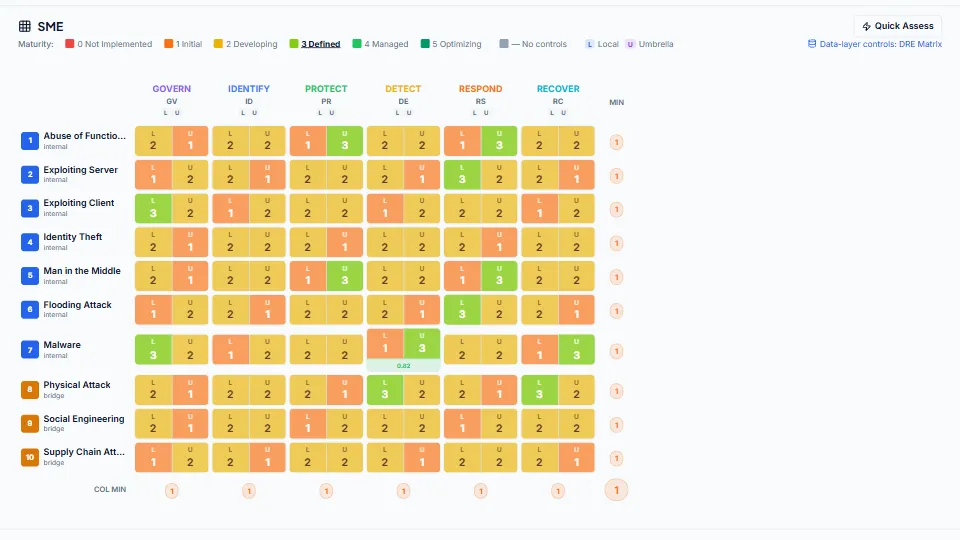
10 Causes × 6 Functions = 60 Control Objectives
Cross the ten clusters with the six NIST CSF functions and control coverage becomes falsifiable: every gap is a named, empty cell.
Structure, not proof: the matrix names the 60 control objectives and makes coverage assessable. A populated cell does not show that a control works — effectiveness needs evidence, such as key control indicators measured against targets.
One Number the Board Understands
“We stopped 100 viruses” is a vanity metric. The Detection Coverage Score (DCS) asks one question per step of an attack path: are you faster than the attacker’s Δt?
Time to detect (d) or to contain (c) at the 90th percentile, against the attack velocity of the step.
Systematically blind to this step: harder-working analysts will not close a five-minute gap, automation will. And seeing is not stopping — only DCSc < 1 contains the step in time.
Tools & Audience Resources
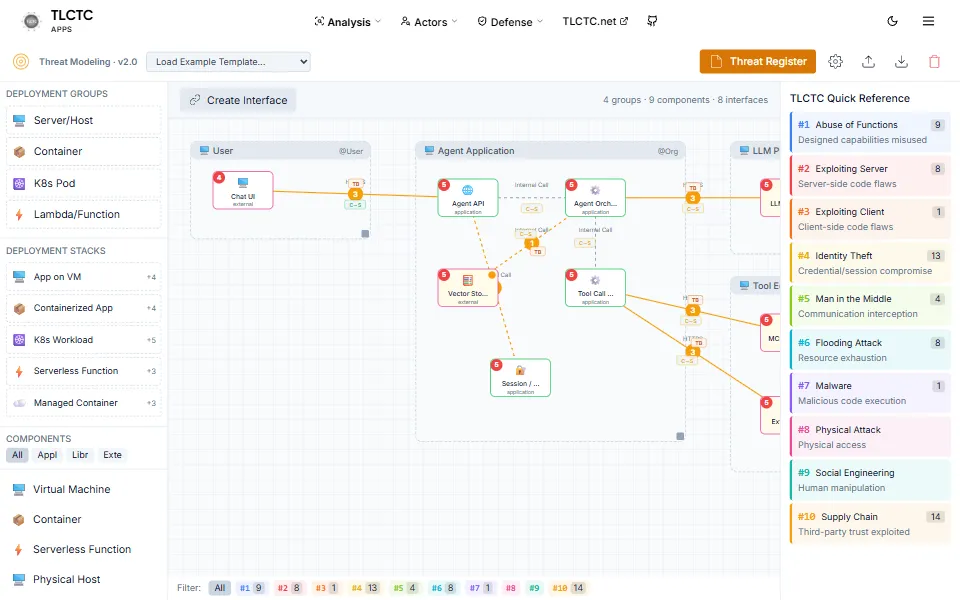
Free proof-of-concept tools that run in the browser, and an AI prompt for every role. The status label is the one from the tool gallery.


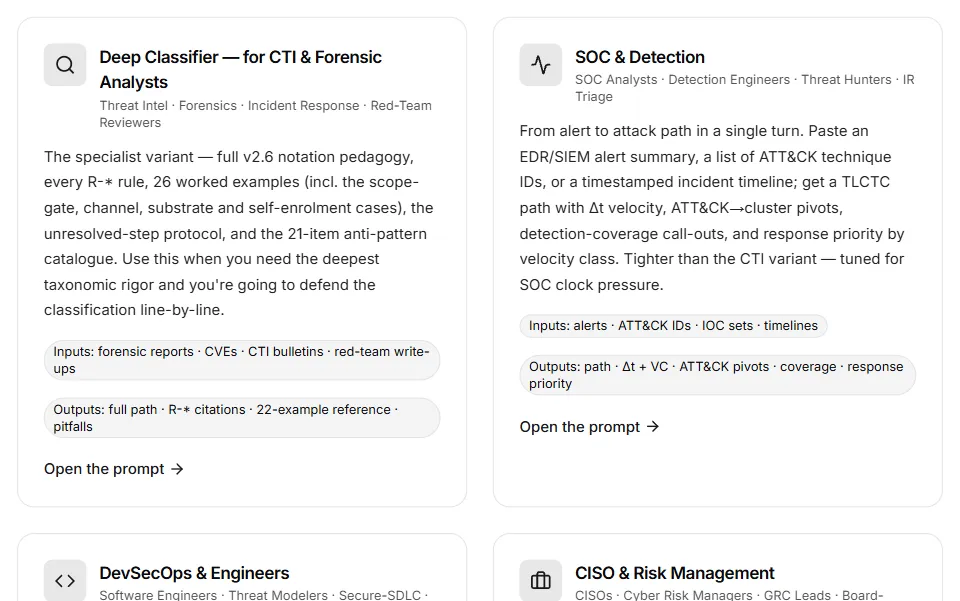
The Monster Prompts without the pasting: the full TLCTC v2.6 canon packaged as an agent skill. Installed once, your agent loads it whenever you ask it to classify an incident, a CVE, a finding or a threat report.
# Claude Code
/plugin marketplace add Barnes70/TLCTC
/plugin install tlctc@tlctc

# any agent the skills CLI supports
npx skills add Barnes70/TLCTCStrategic Leadership
Enable board-level communication across both sides of the Bow-Tie — ten causes on the left, the System Risk Event as pivot, consequences on the right.
Opsec
Map attacker techniques to cause clusters, not outcome labels. Mark where control is lost — the System Risk Event opens the detection window (Δt) response works in.
Development & Engineering
Prioritize weaknesses by the generic vulnerability they expose, not the outcome they might enable. Place each control left or right of the System Risk Event.
Regulators & Standards
Fix the “cyber in the name” taxonomy gap, and give every regime one trigger point on the same event chain.
AI Agents
Give your agent the canon, not a paraphrase. Every TLCTC definition, axiom, rule and mapping is published in machine-readable form, generated from one versioned source, so an agent can cite the definition it applied and its attack paths validate against a schema.
Machine Entry Points/llms.txtSite map for language models
/okf/index.mdOKF bundle: the taxonomy as cross-linked markdown
/.well-known/skills/index.jsonAgent Skills discovery index
tlctc-framework.v2.7.jsonLayer-1 dictionary: clusters, axioms, 17 rules
tlctc-attack-path.schema.jsonLayer-3 schema for attack-path output
tlctc-attack-path.abnfFormal grammar of the attack-path notation
Agents are also attack surface. The same ten clusters classify them: prompt injection and tool abuse are #1, a poisoned model or tool accepted into the environment is #10, a stolen agent token used to log in is #4.
# Claude Code
/plugin marketplace add Barnes70/TLCTC
/plugin install tlctc@tlctc

# Codex, Cursor, Gemini CLI, Copilot …
npx skills add Barnes70/TLCTCRead, Cite, Challenge
The canonical framework: axioms, the ten cluster definitions, classification rules and attack-path notation.
doi:10.5281/zenodo.20633176Putting TLCTC to work: control matrix, key control indicators, governance and reporting.
doi:10.5281/zenodo.22697636The framework in a few pages, for decision-makers.
How the ten clusters are derived — one per generic vulnerability with its own control lever.
Free & open · licensed under CC BY 4.0 — attribution required, commercial use permitted.
The Full Archive, Through Your Lens
Every post, tagged by target audience. Pick your lens — or search the lot.